Choose Between Private and Hard Money: 5 Filters for U.S. Flippers

Hard money is the institutional, productized short-term loan you pull when speed and certainty matter more than cost. Private money is negotiated capital from an individual or small fund, used when the deal doesn’t fit a standard box or you need a longer hold. Hard money runs higher points with predictable underwriting; private money runs on relationship terms that can be cheaper, or can fall apart if your lender’s circumstances change.
TL;DR:
- Hard money offers faster closing times, typically within five to fourteen days, suitable for tight deadlines and standardized underwriting.
- Private money provides flexibility for longer hold periods and deals with nonstandard properties, often through relationship-based negotiations.
- Interest rates on hard money usually range from low single digits to low double digits, with points generally between 1% and 5%, while private rates vary widely.
- Both loan types are asset-backed, but private money carries additional relationship risks due to informal terms, while hard money relies on standardized default clauses.
- To choose the right loan, consider your deal’s timeline, certainty needs, hold length, cost sensitivity, and exit strategy, and verify all terms are documented in writing.
Table of Contents
- Private Money vs Hard Money: The Numbers Side By Side
- What “Hard Money” and “Private Money” Actually Mean
- Rates, Points, LTV, and the 70% Rule
- Which Loan Fits Which Deal
- Where the Risk Actually Sits
- How to Choose Between Them
- Running the Deal Once the Money’s In
- FLIP Runs the Deal After the Loan Closes
- FAQ
Private Money vs Hard Money: The Numbers Side By Side
Points, not rate, decide most of the cost on a three-to-six-month flip.
| Factor | Hard Money | Private Money |
|---|---|---|
| Interest rate | single-digit to low double-digit percentages | vary widely |
| Points/origination | 1% to 5% | 1% to 3% |
| LTV | a moderately conservative percentage | negotiable, deal by deal |
| Term | Months to a few years | Negotiable, often longer |
| Time to close | five to fourteen days | vary by deal |
Pro Tip: Run both scenarios through a hard money loan calculator before you sign anything. Points compound differently than rate once you factor in a real hold period, and the cheaper-looking quote on paper isn’t always the cheaper loan at closing.
Speed buys certainty. Points buy cash flow room. Know which one your deal needs before you call a lender.
What “Hard Money” and “Private Money” Actually Mean
Hard money is asset-based lending, standardized and productized. The lender underwrites the property. Terms come off a rate sheet. Funding follows a set process, usually five to fourteen days.
Private money is negotiated capital from an individual, a family office, a small fund, or a private lending company. Terms vary deal to deal. Some private lenders want a fixed rate and points. Others want profit-sharing or an equity kick instead of, or on top of, interest.
Here’s the terminology problem: hard money is technically a subset of private money, not a separate category. The American Association of Private Lenders and the National Private Lenders Association have both pushed to retire “hard money” as a label, arguing it undersells how these loans actually work today. Modern hard-money-branded lenders often underwrite the borrower’s credit and track record, not just the collateral. The line between “hard money” and “private money” is blurrier in practice than in marketing copy. For deal purposes, the distinction that matters is product versus relationship, not the name on the loan.
Rates, Points, LTV, and the 70% Rule
Hard money interest rates typically are in the single-digit to low double-digit percentage range, with LTV capped at a moderately conservative percentage in many cases. Origination fees and other charges are disclosed upfront on a rate sheet.
Private money rates vary widely and origination fees are often lower compared to institutional loans, reflecting the absence of institutional overhead. Terms vary by deal and may differ significantly even on similar properties.
| Cost Item | Hard Money | Private Money |
|---|---|---|
| Interest rate | Generally between low to mid single digits and low double digits | Varies broadly within a similar range |
| Points | Typically lower single-digit percentages | Varies, often somewhat lower |
| Extension/inspection fees | Usually standardized and disclosed | Negotiated individually and may lack full documentation |
That MAO number has to clear whatever the lender’s LTV cap allows, or you’re bringing more cash to the table than planned.
Which Loan Fits Which Deal
The scenario decides the lender, not the other way around.
- Competitive bid, tight closing window: hard money. Standardized underwriting means the seller believes you’ll close.
- Nonstandard property or a longer hold: private money. A relationship lender can flex on term length, where a hard-money product can’t.
- Repeat pipeline, multiple deals a year: hard money for consistency across deals, private money layered in for the gap between purchase price and loan proceeds.
- First deal, no track record: private money if you have a relationship; hard money if you don’t, because the rate sheet doesn’t care that nobody knows you yet.
Illustrative example: ARV comps at $260,000, repairs scoped at $40,000. Stacking hard money for the bulk of acquisition and private money for the gap is standard practice, not a workaround.
Where the Risk Actually Sits
Both are asset-backed loans. Default on either one accelerates foreclosure, because the lender’s remedy is the collateral, not a payment plan negotiation.
Private money carries relationship risk: informal processes, verbal terms that shift at closing, and capital that can disappear if the lender’s own situation changes mid-project. Hard money carries fee risk: extension penalties, standardized default triggers, and less room to negotiate once you’ve signed the note.
- Confirm clear title before closing.
- Require lender-loss-payable clause on the insurance policy.
- Get the deed of trust and note recorded, not just signed.
- Get the draw schedule in writing, tied to inspection milestones.
- Collect lien waivers from every sub before releasing a draw.
Pro Tip: Treat a private loan with the same paperwork discipline as an institutional one. A handshake deal with a written note and recorded deed of trust is a loan. A handshake deal without them is a dispute waiting for a bad month.
How to Choose Between Them
Run the decision through five filters: timeline, certainty, hold length, cost sensitivity, exit plan. A tight closing date pushes you toward hard money. A flexible hold and an existing lender relationship push toward private money. If cost sensitivity outweighs speed and you can wait on funding confirmation, private money often wins on points alone.
Before signing with either, ask the lender:
- What’s the source of funds, and can I see a written rate sheet?
- What are the extension terms if the rehab runs long?
- Is there a prepayment penalty if I sell early?
- What does the draw schedule look like, and who approves each draw?
- Are there covenants beyond the note, and what triggers default?
- Who’s named on the title insurance and the deed of trust?
Red flags: no written term sheet, oral promises about “flexibility” that aren’t in the note, and vague or missing extension policy. If a lender doesn’t put terms on paper before closing, that’s the term sheet, not a bonus you get later.
Running the Deal Once the Money’s In
The loan terms are one side of the math. The other side is whether the draw schedule and the scope actually match what the lender underwrote against. A draw schedule tied to measurable milestones, backed by lien waivers from every sub before payment, cuts disputes between borrower and lender before they start.
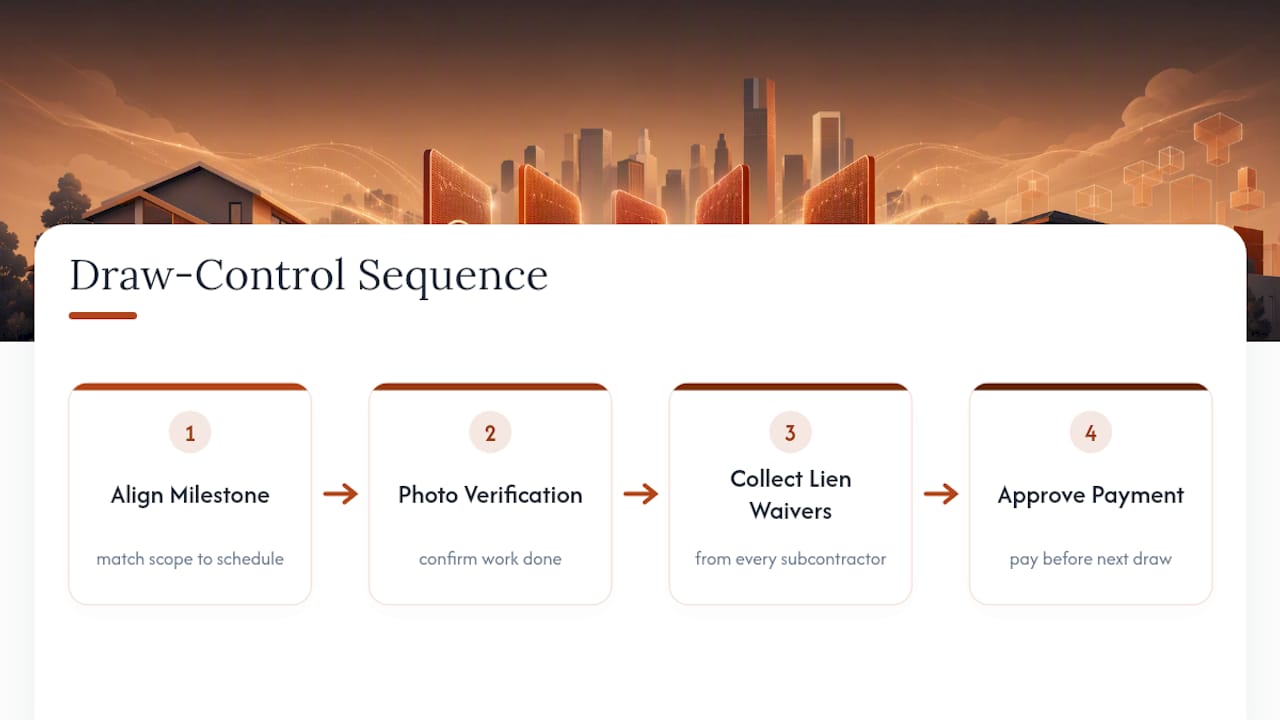
Photo-verified payment approval closes the gap between “sub says it’s done” and “it’s actually done.” That single check point catches disagreements before they become a stalled draw or a lender asking why the schedule slipped.
Run the loan math against your actual hold period, not the term sheet’s best case, using a holding cost calculator alongside the hard-money numbers. Then check the rehab scope against ARV, not against upgrades that don’t move the sale price, with a rehab scope checklist.
FLIP Runs the Deal After the Loan Closes
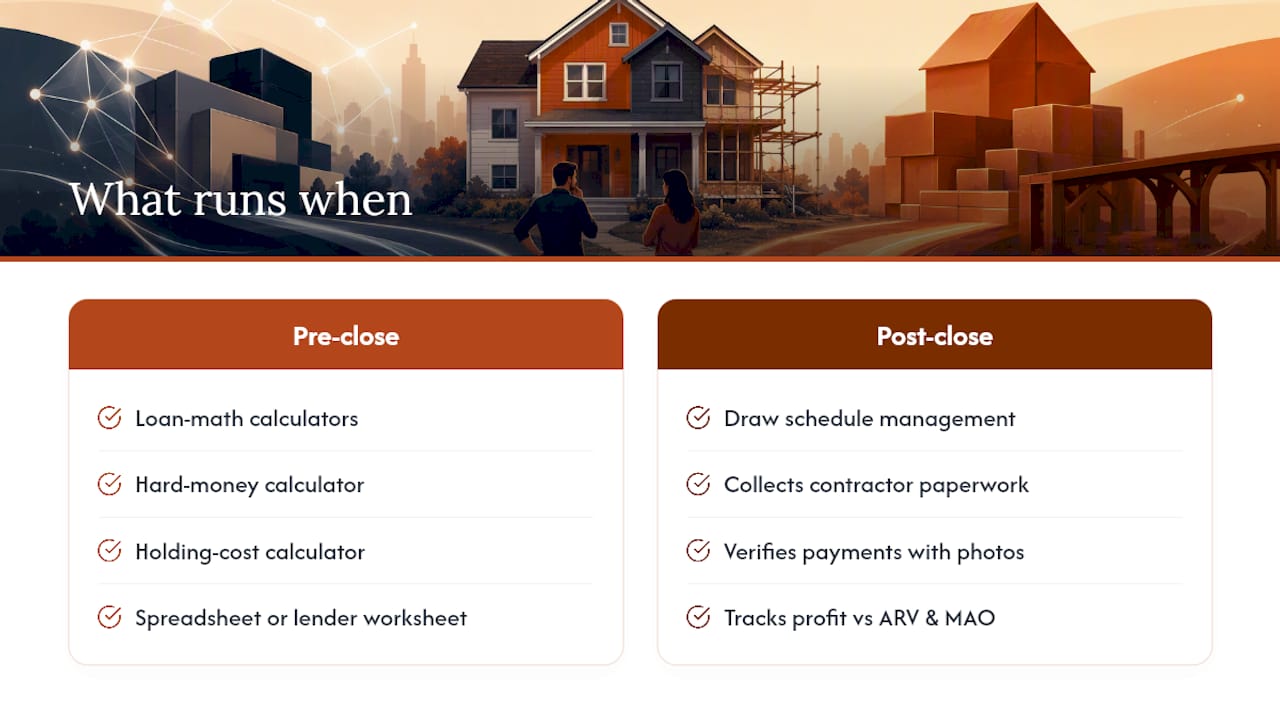
There are other ways to run these numbers: a spreadsheet, a private lender’s own worksheet, or the hard-money vs conventional financing breakdown from Real Estate Investor Toolkit. None of them track your draw schedule against the sub’s lien waivers or your rehab budget against the original underwriting once the loan is funded.
The software picks up where the loan closes. It manages the draw schedule, collects contractor paperwork, verifies payment with photos before a draw releases, and tracks profit against the original ARV and MAO during the rehab. The hard money loan calculator and holding cost calculator run the loan math before you sign; the rest of the product runs the job after you do.
FLIP is pre-launch. There’s no live product to log into yet, but you can get on the list for early access and run your next deal’s numbers through the free calculators now.
FAQ
What Are the Downsides of Hard Money Loans?
Higher points and fees compared to conventional financing, standardized default triggers with less room to negotiate, and extension penalties if the rehab runs past the term.
How Risky Is Private Money Lending?
Both hard money and private money are asset-backed, so default accelerates foreclosure on either. Private money adds relationship risk: informal terms, undocumented changes, and funding that can disappear if the lender’s own situation shifts mid-deal.
What Does Private Money Mean?
Private money is negotiated capital from an individual, family office, small fund, or private lending company, with terms set deal by deal rather than off a standardized rate sheet. It can include profit-sharing or equity terms instead of, or alongside, interest and points.
Recommended
FLIP runs the whole job — scope, subs, schedule and money on one record.