70% Rule for Flippers: MAO Formula and Operator Checklist

MAO is the highest price you can pay for a property and still hit your profit target. The quick formula: MAO = (ARV × 70%) − Estimated Repairs. Run every deal through it before you call the seller back. If the asking price beats your number, pass. No exceptions, no talking yourself into it.
TL;DR:
- The quick MAO formula is only a starting point; detailed underwriting must account for holding, buying, and selling costs to avoid overestimating profit margins.
- ARV accuracy is critical, as even minor errors can significantly skew the maximum offer calculation and affect deal feasibility.
- Running itemized repair bids and factoring in actual loan, holding, and closing costs reduces the risk of deals turning unprofitable due to underestimated expenses.
- For wholesale deals, the MAO must include the target assignment fee, leaving less room for the end buyer’s margin, which tightens the upside potential.
- FLIP offers free calculators and tools, like max offer and rehab scope checklists, to streamline deal filtering and improve underwriting precision before making offers.
Table of Contents
- What the MAO Formula Means and How the 70% Rule Works
- The Detailed MAO Formula: What the Quick Rule Hides
- How to Determine ARV: The Comping Checklist
- Estimating Repair Costs: Scope, Bids, and Contingency
- Fixed Costs: Holding, Financing, and Closing on Both Ends
- Adjusting the Multiplier by Exit Strategy and Market Conditions
- Worked Examples: Flip, Wholesale, and a Conservative Beginner Deal
- Where FLIP’s Calculators Fit Into MAO Underwriting
- Try FLIP’s Free Calculators Before Your Next Offer
- Sources and Calculators Worth Checking
- FAQ
What the MAO Formula Means and How the 70% Rule Works
The 70% rule exists because repairs are only one line item on a flip. Financing, holding costs, closing costs on both ends, and your profit all eat into the same margin. The 30% you’re not paying to the seller has to cover all of it.
Here’s the math in plain terms: take the ARV, multiply by 0.70, then subtract your repair estimate. Whatever’s left is your ceiling.
Example: ARV is $300,000. Repairs run $40,000.
MAO = ($300,000 × 0.70) − $40,000 = $210,000 − $40,000 = $170,000
That $170,000 is the most you offer. Not a starting point for negotiation. The ceiling.
What’s baked into that 30% buffer:
- Financing costs (points, interest on a hard money loan)
- Holding costs (insurance, taxes, utilities, loan payments while you own it)
- Buying and selling closing costs (title, escrow, agent commissions)
- Your target profit margin
The tradeoff is speed for precision. The 70% rule takes thirty seconds and tells you whether a deal is worth a second look. It doesn’t know your actual repair costs, your actual loan terms, or your actual holding timeline. Use it to kill bad deals fast. Every deal that survives the quick filter goes to detailed underwriting before you write an offer. Skipping that second step is how flippers end up upside down on a house that looked fine on a napkin.
The Detailed MAO Formula: What the Quick Rule Hides
MAO = (ARV × Margin%) − Repairs − Holding Costs − Buying Costs − Selling Costs − Assignment Fee (if wholesaling)
Each component:
- ARV — what the house sells for once the work is done. Covered in detail below.
- Margin% — your target multiplier, typically 65% to 75% depending on exit strategy and market. More on this later.
- Repairs — total rehab cost, ideally backed by a contractor bid, not a guess.
- Holding costs — loan interest, property taxes, insurance, utilities, and any HOA fees for every month you own the house.
- Buying costs — closing costs on acquisition: title search, escrow fees, transfer taxes, loan origination fees.
- Selling costs — agent commissions (typically the largest single line), closing costs on the sale side, and any seller concessions.
- Assignment fee — if you’re wholesaling the contract instead of flipping, this is your fee, and it comes off the top before the end buyer’s margin.
Timeline drives most of the variance here. A six-month rehab and a two-month rehab carry wildly different holding costs on the same loan. Interest rates matter too: a hard money loan at a higher rate on a stretched timeline can quietly erase a thin margin before you’ve swung a hammer. Check current rate assumptions against a source like FRED’s housing data before you lock in a holding-cost number, especially if your last deal closed more than a year ago.
Pro Tip: Run the itemized formula with a rough repair number first. Once the deal clears your MAO on paper, get a contractor walk-through and real bids before you sign anything. A rough estimate is fine for a first pass. It is not fine for a final offer.
How to Determine ARV: The Comping Checklist
ARV is the input that breaks the whole formula if it’s wrong. Get it wrong high, and you’ll overpay on a deal that looks profitable but isn’t. Systemized comping controls that risk.
The checklist:
- Pull 3 to 5 comps, sold within the last three to six months, within a half-mile to one mile of the subject property.
- Match bed and bath count as closely as possible. A 3/2 comping against a 4/2 needs an adjustment, not a shrug.
- Adjust for square footage differences using price per square foot, not a flat dollar guess.
- Confirm the comp actually closed (not just listed or under contract) and that it sold as a comparable condition, not as a distressed or as-is sale unless your subject is also distressed.
- Adjust for finishes and features: a comp with a renovated kitchen and a comp with a 1990s kitchen are not the same house even if the square footage matches.
Once you have your comps, convert each to price per square foot, average across the set, then multiply by your subject property’s square footage after renovation. Adjust up or down based on condition and feature differences you couldn’t otherwise account for.
Troubleshooting checklist before you trust the number:
- Are all comps genuinely sold, not pending or expired?
- Is the date range recent enough that the market hasn’t shifted underneath you?
- Did you exclude foreclosure or short-sale comps unless your subject will sell the same way?
- Does the price-per-square-foot spread across your comps stay tight, or is one outlier pulling your average?
Pro Tip: If your comps span more than a $30 per square foot range, you don’t have a comp set. You have noise. Narrow the radius or the date range until the numbers tighten up.
ARV is the most sensitive input in the whole calculation. A small error here doesn’t stay small. It compounds through every downstream number in the formula.
Estimating Repair Costs: Scope, Bids, and Contingency
A repair estimate has three tiers of confidence, and you should know which tier you’re standing on before you write an offer.
- Line-item template estimate. Fast, rough, good for the initial 70% filter. Walk the house, price out roof, HVAC, kitchen, baths, flooring, and paint against a standard per-square-foot or per-unit rate. This gets you a number in an hour, not a promise.
- Contractor walk-through bid. Higher confidence. A general contractor or your subs price the actual scope of work, not a template. This is the number you should be underwriting against before you commit to a purchase price.
- Signed scope of work with draw schedule. The final tier. Once you’re under contract, the scope gets formalized into a document that ties every dollar to a task and a payment trigger.
Contingency sizing depends on how much confidence you have in tier one versus tier two. A rough template estimate needs a bigger contingency than a contractor bid, because the template hasn’t seen behind the walls. Add line-item contingencies for known risk categories specifically: older electrical panels, cast iron plumbing, foundation cracks, or anything you can’t inspect without opening it up.
Document the scope in writing before the rehab starts. A vague scope is how holding costs balloon. If the sub doesn’t know exactly what “update the bathroom” means, they’ll interpret it their way, on their schedule, and you’ll find out the gap when the draw request doesn’t match what you expected.
Fixed Costs: Holding, Financing, and Closing on Both Ends
These are the costs that erode margin quietly, because none of them show up on a rehab punch list. They show up on a bank statement.
- Buying costs: title search, escrow, recording fees, transfer tax, loan origination fees if financed.
- Holding costs: loan interest (the big one on a hard money loan), property taxes, hazard insurance, utilities kept on during rehab, and HOA dues if applicable.
- Selling costs: agent commissions, closing costs on the sale, and any concessions you make to get the deal to close.
- Financing points: hard money lenders typically charge points up front on top of the interest rate, and that cost hits day one regardless of how long you hold the property.
Loan type and repayment schedule change your holding-cost math directly. An interest-only hard money loan front-loads cost predictably, month by month. A loan with a balloon structure or a shorter term forces a refinance or a sale deadline that can pressure you into a worse exit if the rehab runs long. Before modeling holding costs, confirm the lender you’re using is properly licensed. NMLS Consumer Access lets you check that in a few minutes.
Red flags that commonly inflate fixed costs beyond the original estimate:
- Underestimating months held. A “four month flip” that runs six months doesn’t just add two months of interest. It adds two months of taxes, insurance, and utilities too.
- Assuming a flat commission rate without confirming it with the actual listing agent.
- Ignoring seller concessions in a buyer’s market, where you may need to cover part of the buyer’s closing costs to move the property.
- Forgetting utility costs during a vacant rehab, particularly in extreme climates where HVAC has to run to protect the work.
Consumer finance guidance is consistent on this point: build closing costs and holding costs into your budget with realistic numbers, not optimistic ones.
Adjusting the Multiplier by Exit Strategy and Market Conditions
It moves with your exit strategy and the market you’re operating in.
- Wholesale: use a lower multiplier, often 65%, because you need room for both your assignment fee and the end buyer’s own margin. Two parties are eating that buffer, not one.
- Fix-and-flip: 70% is the standard starting point for most markets and most experience levels.
- Buy-and-hold or BRRRR: margins can run looser, sometimes 75%, because you’re not paying a realtor commission to sell and you’re underwriting for long-term cash flow rather than a fast resale.
Market heat changes the calculation too. You’re not just protecting margin, you’re protecting against ARV dropping between your offer and your closing.
Beginners should run the more conservative end of that range regardless of market temperature. You don’t have your own completed-project cost data yet, so you don’t know if your repair estimates run tight or loose. A bigger buffer covers that unknown until you’ve closed a few deals and can calibrate against your own numbers.
When the math doesn’t clear, walk. That’s the entire point of running the formula before you make an offer.
Worked Examples: Flip, Wholesale, and a Conservative Beginner Deal
Example 1: Standard flip
ARV: $320,000. Repairs: $45,000. Holding costs (5 months): $9,000. Buying costs: $4,000. Selling costs (commissions and closing): $19,200.
Quick method: MAO = ($320,000 × 0.70) − $45,000 = $224,000 − $45,000 = $179,000
Detailed method: $320,000 × 0.75 (target margin before itemized deductions) = $240,000. Subtract repairs ($45,000), holding ($9,000), buying ($4,000), selling ($19,200) = $162,800
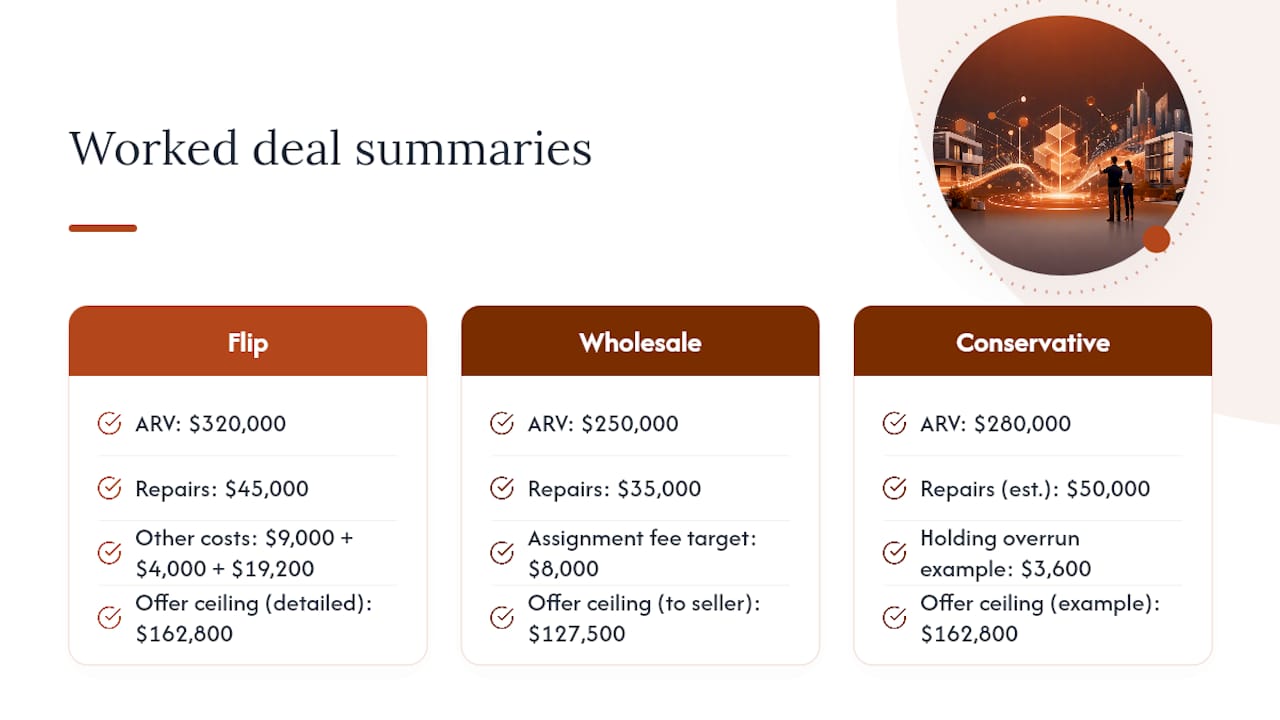
The gap between the quick number and the detailed number, $16,200, is exactly the kind of margin that disappears if you offer based on the quick rule alone and skip the itemized pass.
Example 2: Wholesale deal
ARV: $250,000. Repairs: $35,000. Assignment fee target: $8,000. The end buyer needs their own margin room.
That $127,500 is what you can offer the seller. If the end buyer’s own MAO on this property lands at $135,000, there’s $7,500 of room for your fee. Tight, but workable.
Example 3: Conservative beginner scenario
ARV: $280,000. Repairs: $50,000 (rough estimate only, no contractor bid yet).
The difference, $14,000, is the buffer a first-time flipper is buying against a repair estimate that hasn’t been confirmed by a contractor.
A holding-cost overrun from a two-month schedule slip on the same deal adds another $3,600 in interest and carrying costs. Stack both, and a deal that cleared underwriting at $162,800 is suddenly underwater by the time it closes. That’s why ARV accuracy and realistic holding-cost assumptions matter more than the multiplier you pick.
Where FLIP’s Calculators Fit Into MAO Underwriting
MAO math is only as good as the inputs. Bad comps produce a confident, wrong ARV. Guessed repair numbers produce a confident, wrong ceiling. The formula doesn’t fix bad inputs, it just processes them faster.
FLIP’s early access tools are built around that problem. The max offer calculator runs the 70% rule instantly so you can filter deals before you spend an evening on detailed underwriting. The holding cost calculator itemizes taxes, insurance, utilities, and loan interest by month, so the holding-cost line in your detailed formula reflects your actual schedule instead of a guess. The hard money loan calculator breaks out points and interest so financing costs stop hiding inside a vague “loan cost” line.
For repair scope, a rehab scope checklist organized by house age and condition gives a starting point that’s closer to a contractor bid than a template guess, tightening the variance between your first-pass estimate and the number you’d get from a walk-through.
None of this replaces comping discipline or a contractor bid. It shortens the distance between a rough number and a defensible one. FLIP is in early access. The calculators and templates described above reflect what’s available now.
Try FLIP’s Free Calculators Before Your Next Offer
Running MAO by hand in a spreadsheet works until the deal count goes up and the inputs start drifting between files. FLIP is built to replace that spreadsheet with calculators that stay consistent deal after deal, plus the scheduling and draw tracking that keep holding costs honest once you’re actually in the rehab.
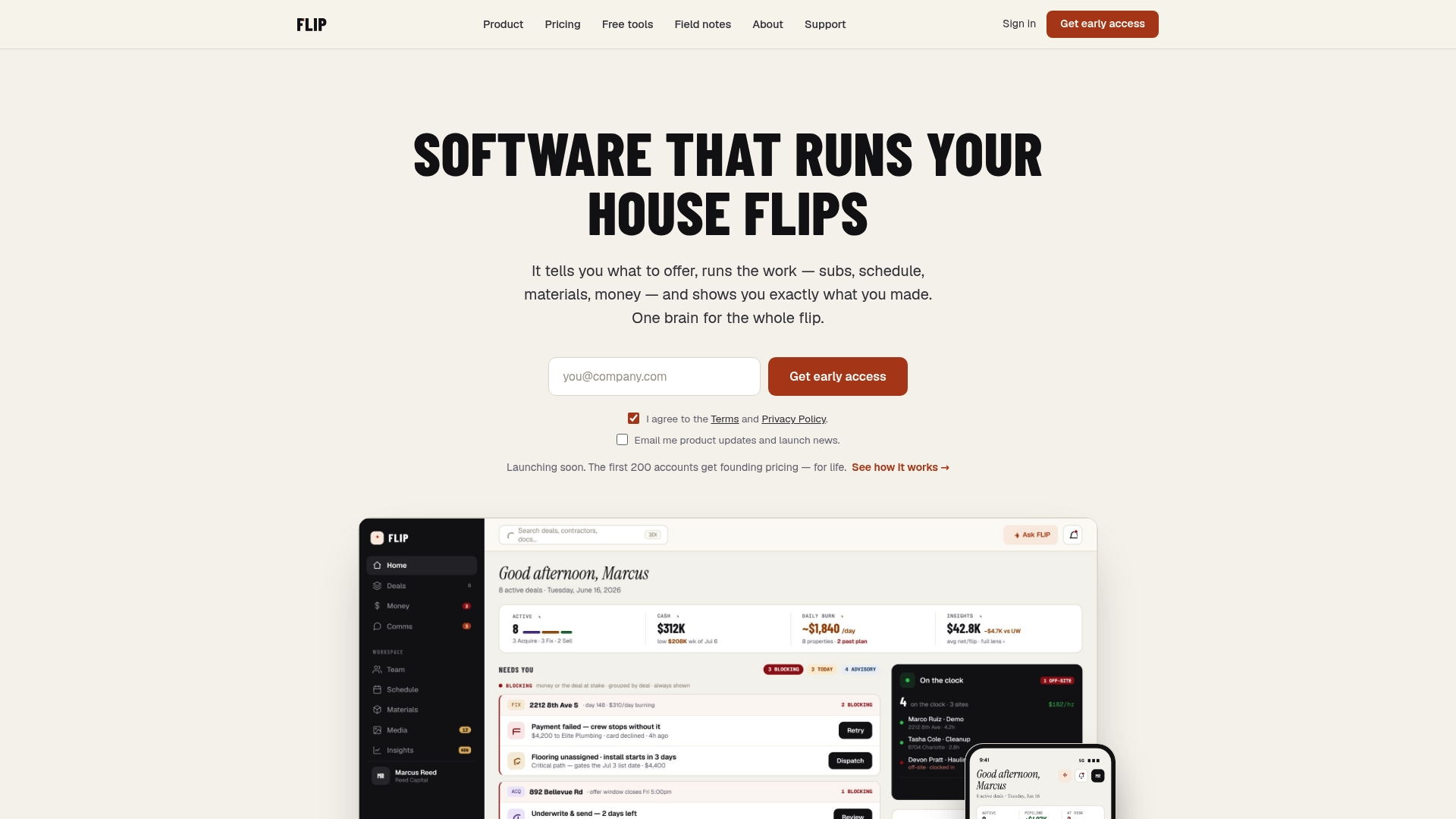
Start with the max offer calculator to filter a deal in under a minute. If it clears, run the holding cost calculator to pressure-test your timeline assumptions, and check the rehab scope checklist against the property’s age and condition before you finalize a repair number. All three are free to use right now on the tools hub.
FLIP itself, the full system that carries a deal from comping through scope, scheduling, draws, and profit tracking against your original underwriting, is in early access. Request access at Flip to get on the list.
Sources and Calculators Worth Checking
- NMLS Consumer Access: verify a lender or loan originator’s license before modeling financing costs
- FRED housing data series: check current rate and housing cost trends before locking in holding-cost assumptions
- FLIP’s free calculators: max offer, holding cost, hard money, and rehab scope tools
- Property investor mistakes to avoid: common underwriting errors to check your process against
FAQ
How Is MAO Calculated?
The detailed method subtracts holding costs, buying costs, selling costs, and an assignment fee (for wholesale deals) from ARV times your target margin percentage before landing on the same ceiling.
What Is a MAO Calculator?
A MAO calculator is a tool that runs the formula for you, taking ARV, repair costs, and your target margin as inputs and returning the maximum price you can pay. FLIP offers a free max offer calculator built on the 70% rule for fast deal screening.
Recommended
FLIP runs the whole job — scope, subs, schedule and money on one record.