Publish a Defensible List Price for Sellers, Authors & Flippers

Set your list price by calculating cost per unit as a floor, checking it against comparable market prices, then adjusting up or down for the value your product or property adds. A flipper working from an ARV of approximately three hundred forty thousand dollars with a rehab budget and holding costs needs a list price that clears enough to cover these plus profit before agent commissions to hit the profit target. The sections below break down the formulas, the comps process, and the adjustments that turn that starting number into a defensible listing price.
TL;DR:
- Setting a home’s list price should start from the after-repair value, subtracting rehab costs, holding expenses, and target profit to determine the maximum acceptable offer.
- Combining all three pricing methods—cost-plus, competitive, and value-based—helps small sellers find an optimal listing price that covers costs and maximizes profit potential.
- Using recent comps within 90 days, in the same neighborhood, and factoring in condition adjustments ensures the list price reflects market realities accurately.
- For flips, an accurate list price must tie directly to current repair scope, rehab spend, and market trends, with real-time calculators supporting ongoing price adjustments.
- Establishing discount strategies and concession limits before listing prevents reactive price wars and preserves margin, especially when competing in crowded markets.
Table of Contents
- Cost-plus, competitive, or value-based: which pricing method fits?
- How do you calculate a list price step by step?
- How do comps and condition affect a home’s list price?
- How do publishers set a list price for a book?
- What tools help you validate a list price before you publish it?
- Why do sellers overprice, and how do you build in discount room?
- How should flippers check a list price before it goes live?
- Price the flip with the numbers, not the guesswork
- Sources and calculators for further reading
- FAQ
Cost-plus, competitive, or value-based: which pricing method fits?
Three methods dominate list price determination, and each one solves a different problem.
Cost-plus pricing adds a fixed markup to your production cost. It is fast, it protects margin, and it ignores what the market will actually pay. Use it when costs are well known and competitors are scarce.
Competitive pricing anchors your number to what similar products or homes are already selling for. It works when you have solid comps and a crowded market, but pricing above the pack demands a real reason. Investopedia’s framework on competitive pricing splits it into three lanes: below market (loss leader), at market (parity), or above market (requires clear differentiation like brand, condition, or features competitors lack).
Value-based pricing starts with what the buyer is willing to pay for the outcome, not what the product cost to make. It produces the highest margins but requires real data on buyer behavior, which most small sellers don’t have on day one.
Most sellers should blend all three:
- Use cost-plus to set the floor, the number you cannot go below without losing money.
- Use competitive pricing to find the realistic ceiling and range.
- Use value-based adjustments to push toward the top of that range when your product or property has a genuine edge.
List price is not the price you expect to collect. It’s the anchor from which every discount, concession, and negotiation starts. Plan the concession before you publish the number, not after a buyer asks for one.
How do you calculate a list price step by step?
The core formula for a physical product is simple, and it’s the same one Shopify’s pricing guide walks through for merchants: cost per unit divided by one minus your desired margin gives you the target price.
- Add up fixed costs — rent, salaries, equipment, anything that doesn’t change with volume.
- Add up variable costs per unit — materials, packaging, per-item labor, shipping, marketplace fees.
- Calculate cost per unit: (fixed costs + variable costs) ÷ units produced or sold.
- Pick your desired gross margin as a decimal (30% margin = 0.30).
- Apply the formula: target price = cost per unit ÷ (1 − desired margin).
- Round to a psychological price ending ($19.99 instead of $20.14) if you’re selling direct to consumers, or to a clean number if you’re selling B2B or listing real estate.
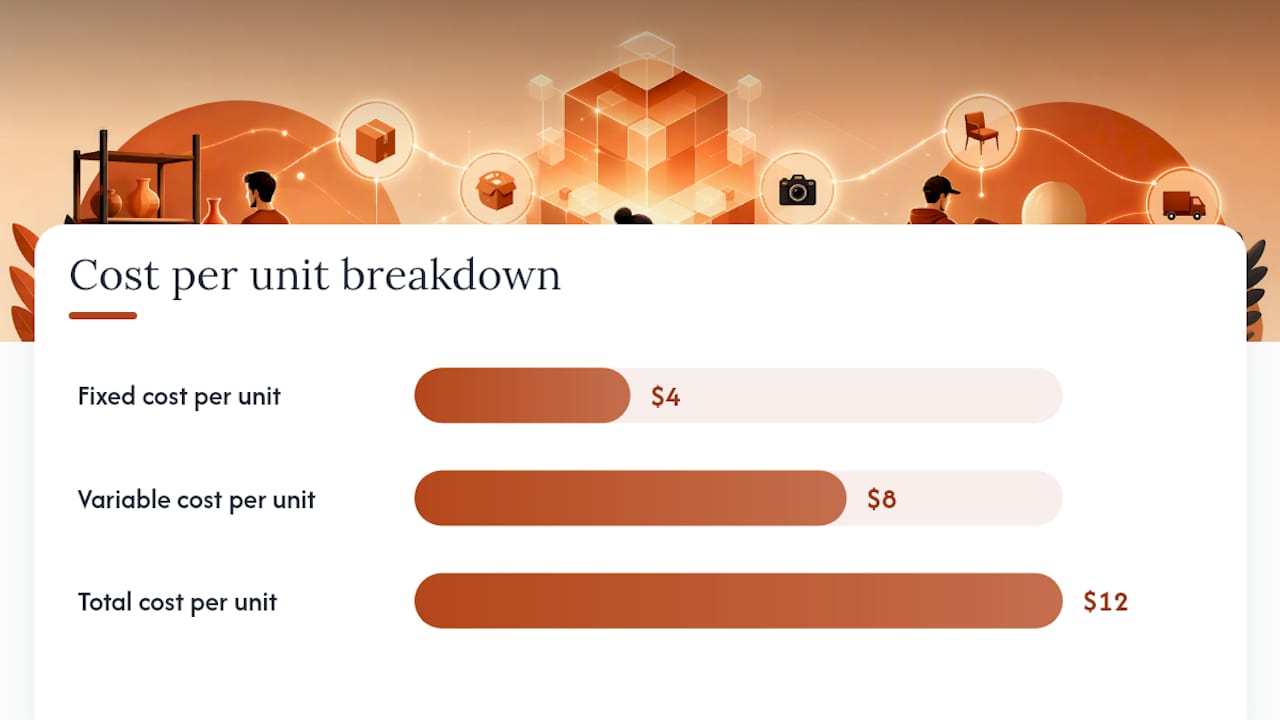
Worked product example: Fixed costs run $2,000 a month, variable cost per unit is $8, and you plan to move 500 units. Cost per unit = ($2,000 + $8 × 500) ÷ 500 = $12.
Worked house example: ARV comes in at $340,000. Rehab budget is $45,000, holding costs (interest, insurance, utilities) run $12,000 over a four-month timeline, and you want a $40,000 profit floor before agent commissions and closing costs. Minimum acceptable list price = $340,000 target sale minus nothing, since ARV is your target sale price. The number that actually matters is your maximum allowable offer on the buy side: MAO = ARV − rehab − holding − profit − commissions/closing (typically 8 to 10% of ARV). That’s the check that keeps the deal from starting upside down.
Statistic to anchor this: cost accounting frameworks from the U.S. Chamber of Commerce stress that pricing has to account for both fixed and variable costs against what competitors charge for similar goods. Skip either side of that equation and the number you publish is a guess, not a price.
How do comps and condition affect a home’s list price?
A home’s list price rides on comparable sales, not on what you paid, what you spent, or what you hope to net. HomeLight’s guidance on home pricing points to five recurring factors: location, comparable sales, home condition, market timing, and pricing strategy relative to demand.
Weighting comps correctly matters more than finding a lot of them.
- Recency: sales from the last 90 days carry more weight than sales from a year ago, especially in a moving market.
- Proximity: same subdivision or school zone beats same zip code.
- Size: adjust per square foot rather than comparing raw sale prices when homes differ by more than 200 to 300 square feet.
- Condition: a fully rehabbed comp isn’t a fair match for a home that needs a roof. Adjust down for deferred maintenance, up for recent updates.
For flippers, the workflow runs backward from ARV. Start with the after-repair value pulled from comps, subtract the rehab budget, subtract holding costs across the projected timeline, subtract your target profit, and what’s left is your maximum allowable offer on acquisition. On the sale side, list price gets set at or near ARV, adjusted for how the comps are trending the week you list, not the week you bought.
Pro Tip: Run a pre-listing comparative market analysis (CMA) and, on higher-value flips, a pre-listing appraisal. A CMA from an agent costs nothing. An appraisal costs a few hundred dollars and catches condition or comp mismatches before a buyer’s appraiser catches them for you, mid-contract, at a worse moment.
Once listed, watch days-on-market and showing pace. A home that draws showings but no offers in the first two weeks is priced at or slightly above market. A home with no showings is priced wrong, not just unlucky.
How do publishers set a list price for a book?
For self-published authors, the author sets list price directly. For traditionally published titles, the publisher sets it, factoring production cost, target author royalty, and distributor cuts.
The royalty-impact formula publishers actually use looks like this: royalty = (royalty rate × list price) − delivery costs.
Print and ebook pricing diverge because their cost structures diverge:
- Ebooks carry near-zero marginal cost per unit but a delivery fee charged by the platform, based on file size.
- Print books carry per-unit printing cost, plus a return allowance retailers negotiate, which publishers have to bake into the list price or absorb from margin.
- Comparable titles in the same genre and length set the market ceiling. A $28 hardcover in a genre where comps run $16 to $19 will underperform regardless of how good the book is.
List price for books is a royalty lever first and a market signal second. Move it carelessly and you move your own paycheck.
What tools help you validate a list price before you publish it?
Run the numbers through a calculator before the number goes live anywhere. Profit margin calculators, break-even calculators, and for flippers specifically, flip profit and holding cost calculators, catch math errors that a gut-check price misses.
For direct-to-consumer sellers, track conversion rate and revenue per visitor at the price you set, then test a second price point over a defined window (two weeks minimum, longer if traffic is thin) before drawing conclusions. FitSmallBusiness’s pricing guidance treats this as standard practice: cost-plus sets the floor, competitive pricing sets the range, and short controlled tests find the number that actually performs.
| Check | What it tells you |
|---|---|
| Break-even calculator | Minimum price to cover total cost at your expected volume |
| Profit margin calculator | Whether your target margin survives after fees and shipping |
| A/B price test (2+ weeks) | Which price point converts better without cratering volume |
| Comp range check | Whether your number sits inside, below, or above the realistic market band |
Before publishing anywhere, run a three-item check: every cost is accounted for, the number sits inside a market range you can defend, and you have some signal, even informal, on what buyers will actually pay. Marketplace platforms like Amazon Seller Central also require that a displayed list price reflect a real recent price or a genuine intended offer, not an inflated reference number designed to make a discount look bigger.
Why do sellers overprice, and how do you build in discount room?
Overpricing stalls sales because buyers comparison shop before they act, on a product page or a home listing. A price that sits visibly above the comp range gets skipped, not negotiated. Underpricing has the opposite failure mode: it clears fast and quiet, and the seller never finds out how much margin got left on the table.
The fix is setting discount rules before the price goes live, not during a negotiation.
- Set a maximum concession range as a percentage of list price, which typically varies by industry and category.
- Require approval above that range instead of letting a single salesperson or agent grant it ad hoc.
- Track competitor promo patterns so a discount responds to a plan, not a panic.
Pro Tip: List price is the top of the pricing waterfall. Every discount, rebate, or concession pulls the number down toward pocket margin. If you haven’t mapped that path before you list, you’ll discover it one angry negotiation at a time.
Avoiding reactive price wars means deciding your floor before a competitor forces the question.
How should flippers check a list price before it goes live?
The math for a flip runs in one direction: ARV first, everything else subtracted from it.
- Pull ARV from recent, close, condition-adjusted comps.
- Build the rehab budget from a scope, not a guess. Scope to the ARV, not to taste.
- Run holding costs across the realistic timeline, including interest on any hard money loan.
- Subtract target profit and expected closing costs to land on MAO for the buy side.
- Set list price on the sale side at or near ARV, adjusted for how comps are moving that week.
FLIP is building toward tools that run these numbers automatically as a flip progresses, including a holding cost calculator and a flip profit calculator, so the list price stays tied to real rehab spend instead of the number from underwriting three months earlier. Early access covers flippers running this math manually today.
Price the flip with the numbers, not the guesswork
Every method above works on paper. It breaks down the moment rehab runs over budget, holding costs stretch past the original timeline, or the comp set shifts while a property sits under contractor draw schedules.
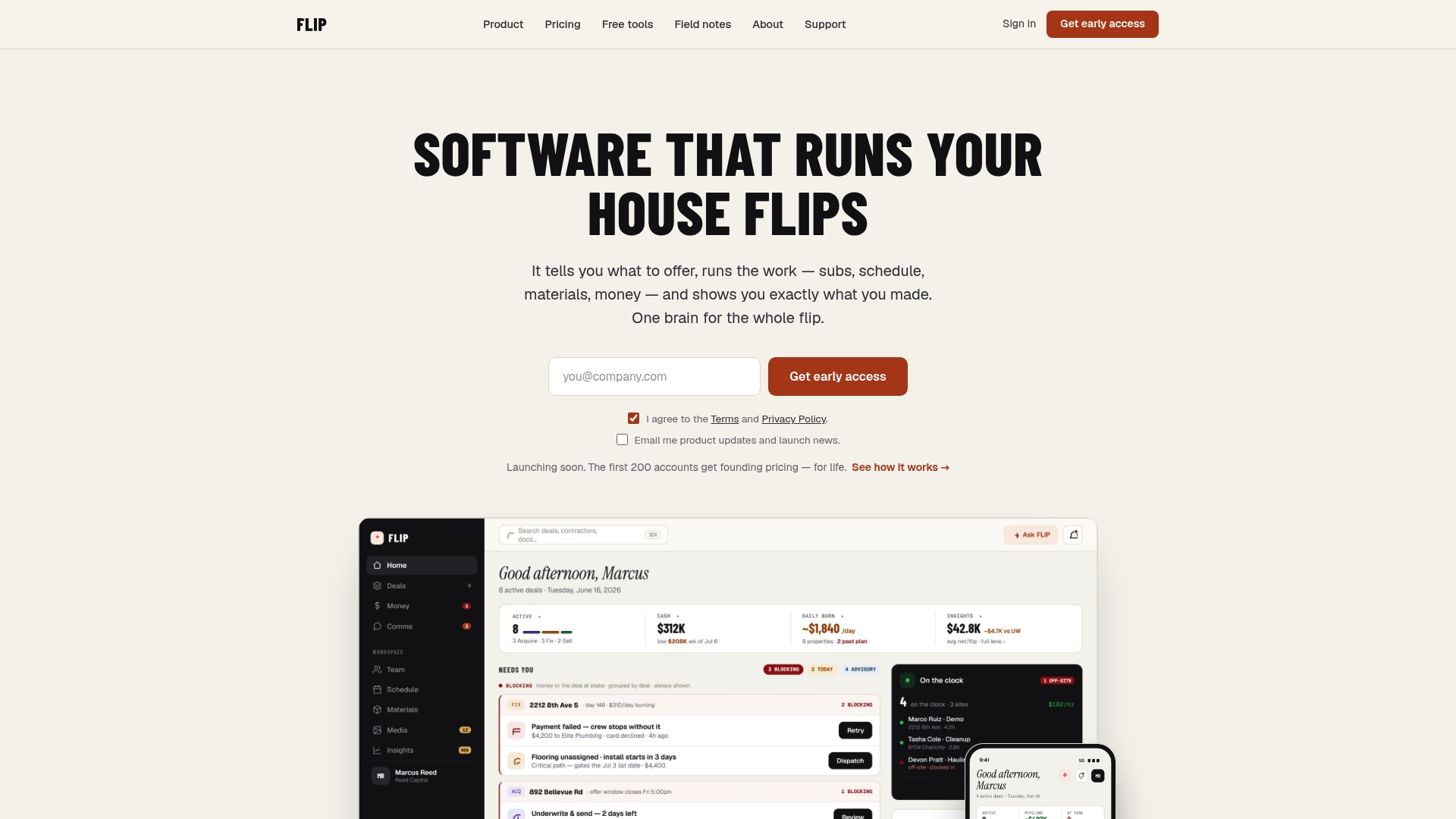
FLIP is the operations layer that keeps ARV, rehab scope, draw schedules, and holding cost in one system instead of three spreadsheets and a text thread. A flipper computing list price mid-rehab can run the flip profit calculator against actual spend to date, not the budget from underwriting, and check the holding cost calculator before deciding whether to hold for a better comp season or list now. The rehab scope checklist keeps the scope tied to ARV instead of drifting toward finishes that don’t move the sale price.
Contractors and subs log into the same product, free, using a phone number. Lien waivers and W-9s live with the job, not in a separate folder. Get on the list for early access and start running list prices off real numbers instead of the number from three months ago.
Sources and calculators for further reading
- Free flip calculators — ARV, flip profit, holding cost, and hard money cost, in one place.
- Property investor mistakes to avoid — common comp and renovation-premium errors that distort pricing.
FAQ
How do you set up a price list?
List every SKU or listing with its cost inputs, target margin, and comp range, then compute the target price for each using cost per unit divided by one minus desired margin, adjusted for value differentiators.
How do you calculate a list price?
Add fixed and variable costs to get cost per unit, then divide that by one minus your target margin as a decimal. For a home, start from ARV and adjust for condition, comps, and current market pace instead.
What is a price list template?
A price list template is a structured sheet, often built in a spreadsheet or generated by a pricing calculator, that lists each product or service alongside its cost, margin, and resulting list price for consistent publishing across a catalog.
Recommended
FLIP runs the whole job — scope, subs, schedule and money on one record.