Avoid $40,000: Capped Discovery Fixed Price vs T&M for Flippers

Fixed-price works when the scope is locked and the house has no surprises left to find. Time-and-materials works when the scope is still moving, usually because nobody has opened the walls yet. Most experienced flippers end up running a hybrid: a capped time-and-materials discovery phase to find the unknowns, then a fixed-price contract for the execution work once the scope is real. The trade underneath both models is simple. Fixed-price puts change risk on the contractor. T&M puts it on you.
TL;DR:
- Fixed-price contracts are ideal when the scope is fully defined and risks can be accurately priced upfront, especially for cosmetic rehabs.
- Time-and-materials contracts suit projects with significant unknowns, where scope growth is common, but they require rigorous administrative oversight.
- Hybrid approaches with a capped T&M discovery phase followed by fixed-price execution help mitigate unknown risks while controlling costs.
- Proper contract clauses, including change order procedures and clear milestone acceptance, are essential to enforce governance and prevent scope creep.
- Monitoring through photo-verified progress and strict change management is critical to controlling costs and timelines under either contract type.
Table of Contents
- Fixed Price vs Time and Materials: How Each One Actually Bills
- What Fixed Price and T&M Cost You in Practice
- Building a Decision Framework for Contract Type
- Contract Clauses That Determine Whether Either Model Works
- The Hybrid That Most Experienced Flippers Actually Run
- The Math Behind Buffers, Markups, and NTE Caps
- Estimating Cost and Duration Under Each Model
- What Real Rehab Outcomes Look Like Under Each Model
- Negotiating Terms Without Giving Away Your Margin
- Keeping Costs and Timelines Under Control While the Job Runs
- How FLIP Helps You Enforce the Governance Either Model Needs
- FAQ
Fixed Price vs Time and Materials: How Each One Actually Bills
Federal procurement guidance draws the line between these contract types mainly on risk allocation, and that framing holds up on a rehab job as well as it does on a government contract. A firm-fixed-price contract sets one number for the defined scope. The contractor eats any overrun; you eat none of it, as long as the scope doesn’t change. A fixed-price contract with economic price adjustment is a variant used when a job runs long and material costs are unstable, lumber during a price spike, for example. It lets the price move with a named index instead of forcing the contractor to eat volatility they can’t control.
T&M works differently. You pay an hourly rate per labor category, plus materials at cost. Contractors commonly add a markup on those materials, typically in the 15% to 35% range, to cover procurement time and carrying the material cost until you pay the invoice.
Profit and overhead land in different places depending on the model:
- Fixed-price: profit and overhead are baked into the bid price up front, invisible to you as a line item.
- T&M: profit and overhead show up as the markup on materials and the built-in margin inside the hourly rate.
- Hybrid: discovery phase bills T&M with a cap; execution phase reverts to fixed-price once scope is locked.
What Fixed Price and T&M Cost You in Practice
Fixed-price gives you a number you can take to a lender or a partner. That’s the entire appeal. The contractor absorbs the overrun risk, and in exchange, they price in a risk premium. Practitioner estimates put that premium at a significant portion above the real expected cost. You pay it whether or not anything goes wrong. If the scope holds and no surprises surface, you handed over a buffer for nothing.
T&M flips that. If the scope shrinks or the job goes smoothly, you pay less than a fixed-price bid would have charged, because there’s no premium sitting on top of the estimate. If the scope grows, and on a rehab it usually does, you pay for every hour of it. Without governance, that’s an open checkbook.
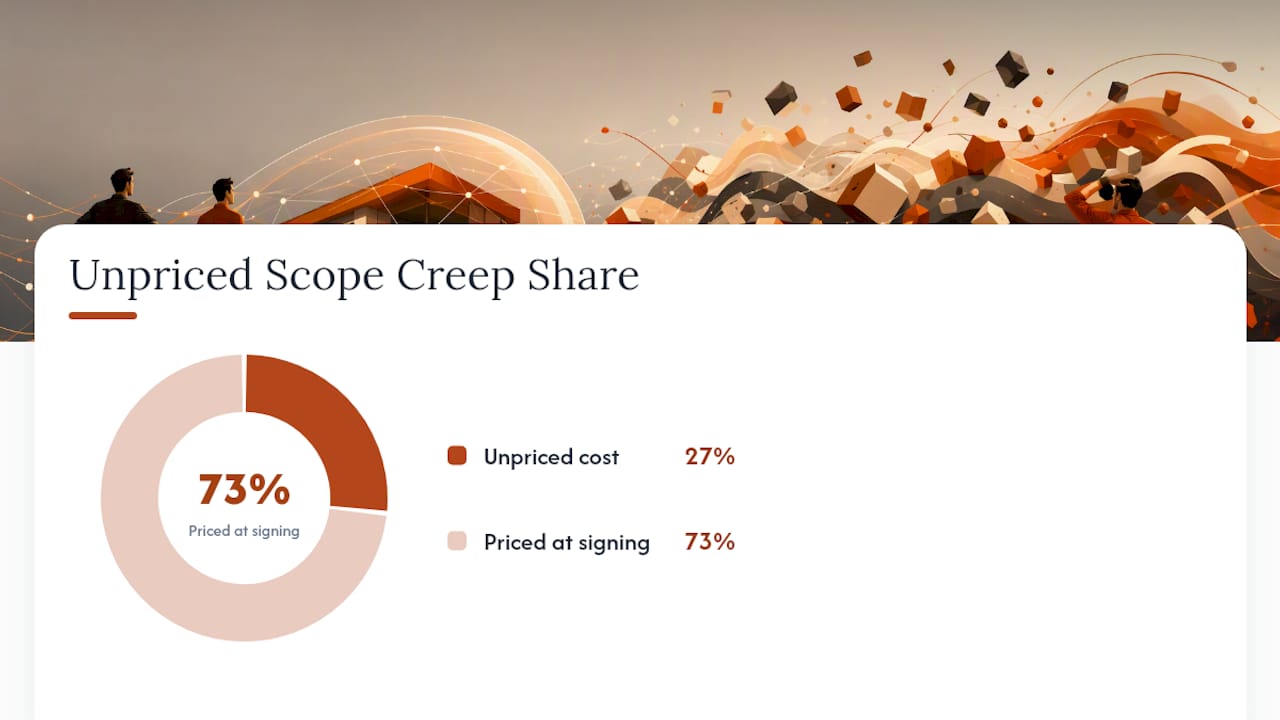
Scope creep isn’t rare. It’s closer to the default. Industry data indicates that scope creep occurs in a substantial share of projects, often leading to notable cost impacts. On a $150,000 rehab, that’s roughly $40,000 in cost that nobody priced at signing.
Here’s how the two models compare on the factors that matter most to a flipper:
- Cost predictability. Fixed-price wins outright. The number on the contract is the number you underwrote to.
- Total cost if scope holds. T&M usually wins. No risk premium sitting on the invoice.
- Total cost if scope grows. Fixed-price wins, but only through change orders, which functionally convert part of the job to T&M anyway.
- Contractor incentive to cut corners. Higher under fixed-price, since every unbilled hour is pure margin for them.
- Owner administrative load. Higher under T&M. Somebody has to review hours and material receipts every week, not sign one check at the end.
Building a Decision Framework for Contract Type
Run the scope through four questions before you pick a contracting model.
- Is the scope of work fully defined? If the inspection, the comps, and the scope of work all agree on what’s being done, fixed-price is the right call.
- Is there real uncertainty behind a wall, under a slab, or in a permit office? If yes, don’t let a contractor guess a fixed number. Guessing gets priced as a bigger risk premium, and you pay for a guess either way.
- What’s the project duration? Longer timelines mean more exposure to material price swings. Past 90 days, consider economic price adjustment language even inside a fixed-price structure.
- Do you have the bandwidth to govern T&M? Weekly time sheet review, invoice line-item checks, and a fast change-order signoff process are non-negotiable if you go T&M. No bandwidth, no T&M.
Rule of thumb: cosmetic rehabs on houses you’ve comped thoroughly go fixed-price. Structural unknowns, additions, or anything touching a foundation, a roofline, or old electrical goes T&M with a not-to-exceed cap until the unknowns are known.
Pro Tip: Set the not-to-exceed cap at or near your contingency line from underwriting, not above it. If the contractor hits the cap before the scope is done, that’s your signal to stop and re-scope, not to raise the cap and keep paying.
Contract Clauses That Determine Whether Either Model Works
The model on the cover page matters less than the clauses inside it. Weak paperwork breaks a good fixed-price deal and turns a fair T&M deal into a blank check.
Build every contract, regardless of model, around this checklist:
- Scope-change process: written change order, priced before work starts, signed by a named approver.
- Acceptance criteria per milestone: what “done” means for drywall, for rough-in, for final paint. Vague acceptance language is where disputes live.
- Named team on the job, not just a company name on the letterhead.
- Not-to-exceed ceiling on any T&M phase or discovery phase, tied to your contingency budget.
- Economic price adjustment language if the job runs past 90 days in a volatile material market.
- Lien waiver requirements tied to every draw, unconditional on final payment.
Recordkeeping is what makes those clauses enforceable:
- Time sheets logged daily, not reconstructed weekly from memory.
- Photo-verified progress tied to each draw request, not a phone call saying it’s done.
- Invoice line-item detail on every T&M bill: hours, rate, labor category, material receipt.
- Weekly review cadence where the contractor walks the job against the schedule and the draw schedule against the budget.
An NTE clause without weekly burn review is a number on paper. It stops nothing on its own.
The Hybrid That Most Experienced Flippers Actually Run
A capped T&M discovery phase, followed by fixed-price execution, is the pattern practitioner guides converge on for a reason: it forces the unknowns into the open before anyone commits to a number. Discovery should be short, days, not weeks, and it should produce three things: a written scope of work, a risk register naming every open question, and acceptance criteria specific enough that a second contractor could bid off them.
That output is what lets you convert discovery into a fixed-price phase without inflating the risk premium. A contractor pricing a known scope doesn’t need to pad for surprises they haven’t found yet, because discovery already found them.
| Discovery deliverable | Why it matters for the fixed-price conversion |
|---|---|
| Written scope of work | Removes ambiguity that drives change orders later |
| Risk register | Names unknowns so they get priced or excluded explicitly |
| Acceptance criteria | Gives both sides a fixed-price bid can be tested against |
Trigger for conversion: once the risk register is closed out or every open item has a priced allowance, move the job to a fixed-price contract for execution.
The Math Behind Buffers, Markups, and NTE Caps
Run a $100,000 rehab three ways.
- Fixed-price: contractor bids an amount that includes a moderate risk premium against unknowns. You pay that number even if zero surprises show up.
- T&M, no cap: hours times rate plus material markup. If scope grows 20% mid-job, your invoice grows roughly the same, with no ceiling stopping it.
- T&M with a 15% NTE cap: billing stops at $115,000 unless you sign a change order raising the cap. Scope growth still costs you, but it’s visible and approved, not discovered on the final invoice.
The bookkeeping tells the real story. On a fixed-price job that blows past its number, the paper trail is thinner, because change orders on fixed-price contracts often get handled verbally until the final bill lands. Governance, not contract type, is what keeps either number close to what you underwrote.
Estimating Cost and Duration Under Each Model
Fixed-price estimating starts with the scope of work, not the calendar. Price every line item against comps and recent contractor bids, then add contingency, typically the same percentage you’d expect a contractor’s risk premium to run. Duration gets built off the draw schedule: tie each draw to a completed milestone, not a date, so a delay in framing doesn’t silently compress your finish-work timeline.
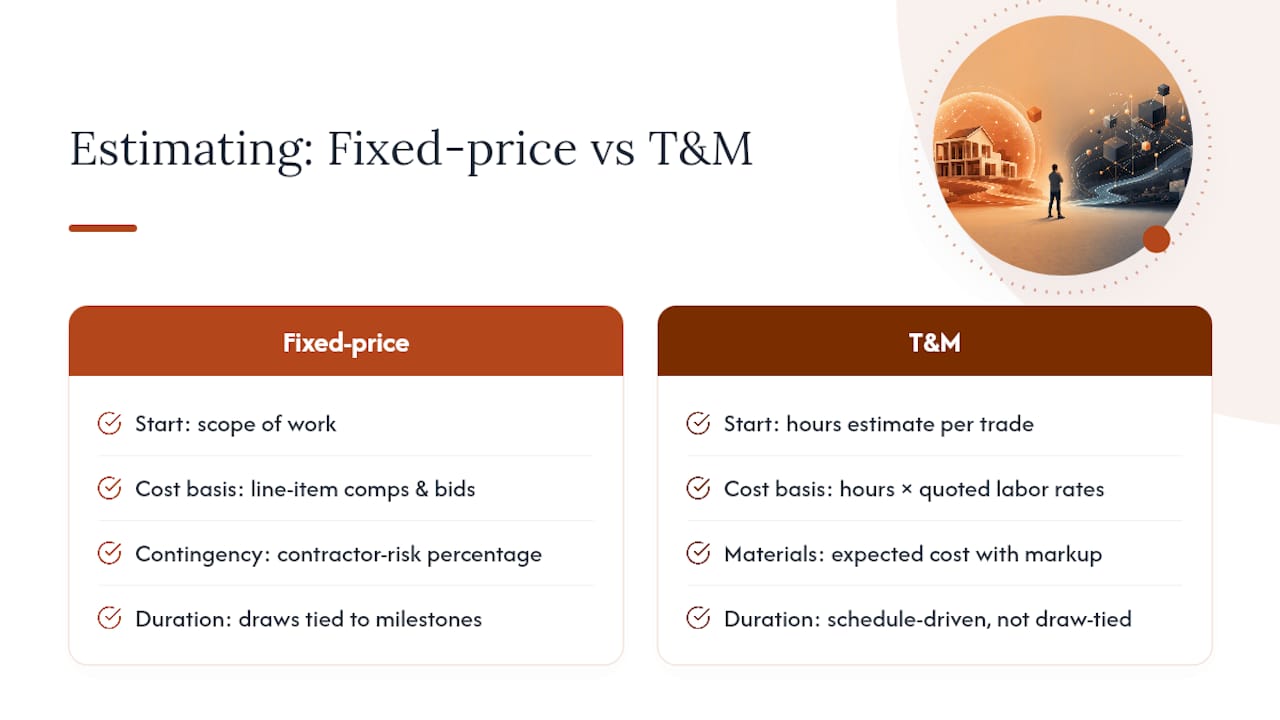
T&M estimating starts differently. Build an hours estimate per trade, based on square footage and scope complexity, then multiply by the labor category rates the contractor quoted. Add expected material cost with the markup already factored in. The estimate is a range, not a number, and that range should tighten as discovery closes out unknowns.
Both models fail the same way when the underlying comps are wrong. A rehab budgeted against soft comps will blow its fixed-price number just as fast as it blows a T&M cap, because the ARV never supported the scope in the first place. Estimating discipline starts before the contract type gets picked, at the comping and underwriting stage, and a tool like FLIP’s holding cost calculator can show how a slipped duration compounds carrying costs regardless of which contract model you signed.
What Real Rehab Outcomes Look Like Under Each Model
A cosmetic flip, paint, flooring, counters, fixtures, on a house with a clean inspection, is the textbook fixed-price win. Scope is fully known before the contract is signed, the contractor prices it tight, and the draw schedule ties to visible milestones. Overruns are rare because there’s almost nothing left to discover.
Compare that to a flip where the inspection missed foundation movement, and the contractor is midway through a fixed-price contract when the crawl space reveals a bigger problem. That’s where fixed-price contracts fail hardest: the change order negotiation happens under duress, with the contractor holding leverage because the job is already half torn open. Construction industry reporting consistently flags cost overruns as common on this type of surprise, and the contract type in force at the time of discovery determines who eats it.
A gut renovation with an old electrical panel, unknown plumbing routing, and a questionable roof is the T&M case, run with a capped discovery phase first. Discovery finds the panel needs replacing and the roof needs a partial tear off before a single fixed-price number gets written. The execution contract that follows prices a known scope, and the risk premium on it stays small because there’s little left to guess at.
Negotiating Terms Without Giving Away Your Margin
Fixed-price negotiation is a negotiation over the risk premium, whether either side names it that way or not. Ask the contractor to itemize their contingency assumptions instead of accepting one lump number.
T&M negotiation is a negotiation over rates and caps, not over the total. Lock the hourly rate per labor category in writing before work starts, and negotiate the material markup percentage rather than letting it float. Push for the NTE cap to sit at or near your underwritten contingency line, not above it, and require written approval, not a text message, before any change order raises that cap.
In both models, negotiate the draw schedule as hard as the price. A draw schedule tied to vague percentages of completion invites disputes about what percentage was actually done. A draw schedule tied to named, inspectable milestones, framing complete, rough-in passed, drywall hung, removes the argument before it starts. Lien waivers should be a condition of every draw, not an afterthought at closing, because an unconditional waiver at final payment is the only thing standing between you and a surprise claim after the sale.
Keeping Costs and Timelines Under Control While the Job Runs
Fixed-price jobs still need monitoring, even though the number is locked. Walk the job weekly against the draw schedule, not just at draw time, so a slipping timeline shows up before it costs you a delayed closing. Compare completed work physically against the milestone that triggered the draw before you release payment, not after.
T&M jobs need tighter monitoring, because the invoice total isn’t fixed. Review time sheets weekly against the hours you expected for that phase of work. Flag any labor category running consistently over its expected hours before three more weeks of billing stack on top of it. Track material receipts against the markup percentage in the contract, since an unverified markup is where T&M invoices quietly drift.
Across both models, the discipline that actually controls outcomes is the same: photo-verified proof tied to every payment, a change order signed before extra work starts rather than after, and a single named person on your side who has authority to approve or reject a change. Without that person, every contractor request becomes a negotiation, and every negotiation costs time you didn’t budget for.
How FLIP Helps You Enforce the Governance Either Model Needs
Contract type sets who carries the risk. Governance decides whether that risk ever turns into real dollars. FLIP is built to run the governance layer on either model: budgets tracked against your original underwriting, work orders and sub bidding tied to a defined scope, and payment approval that requires a photo before a draw releases.
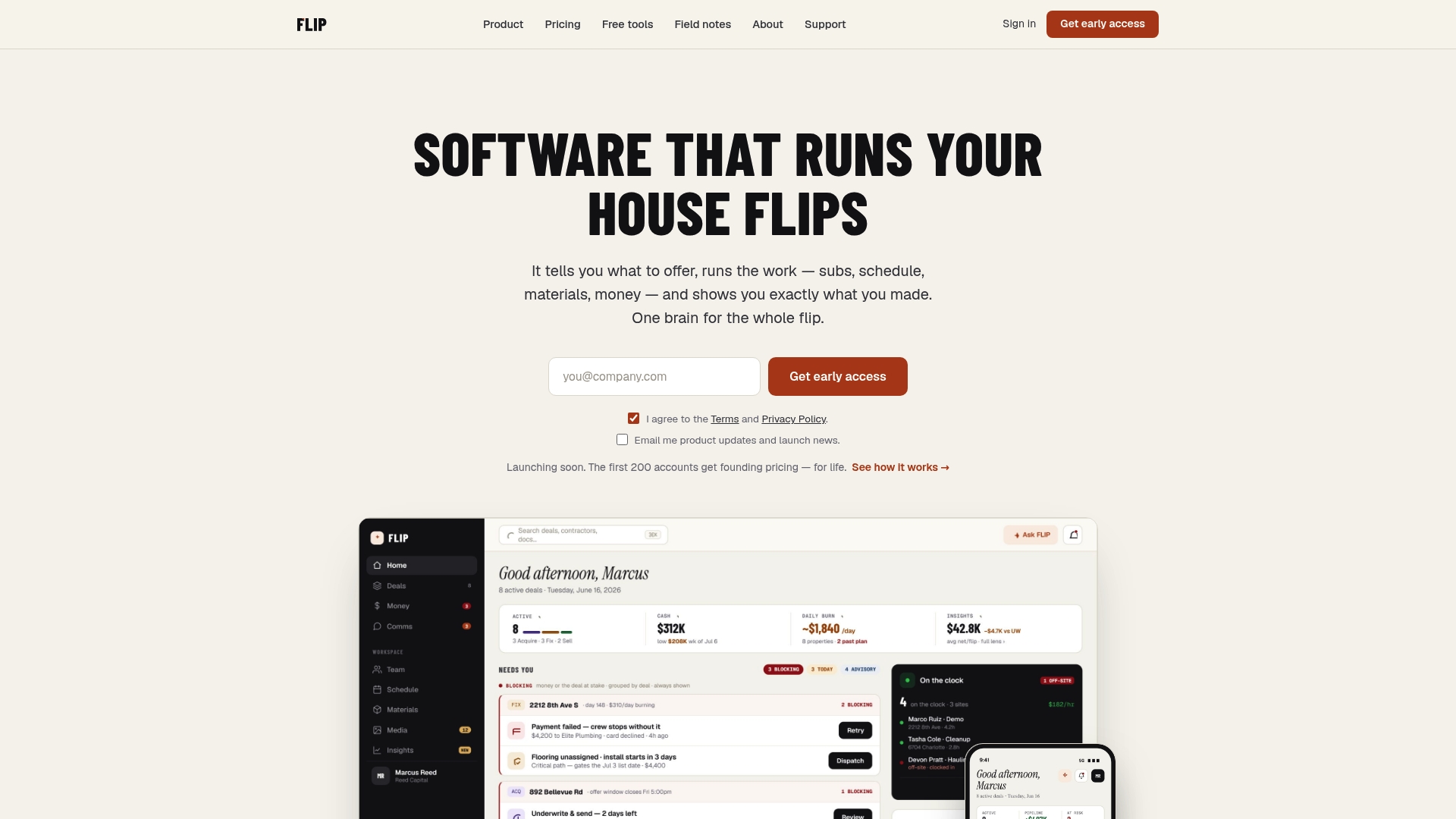
Subs log in through their own phone number, submit progress, and get paid against verified work, not a phone call claiming the job is done. That structure supports the exact controls this article covers: photo-verified milestones instead of trust, line-item work orders instead of vague scope, and profit tracked against the ARV and repair budget you underwrote at acquisition, not a number that drifts as change orders pile up.
FLIP is in early access. If you’re deciding between a fixed-price bid and a T&M arrangement on your next flip, FLIP’s free flip calculators can model the holding cost and profit impact of either path before you sign anything, and the product overview walks through how budget tracking and work orders tie back to your original comps and ARV.
FAQ
Which Is Better, Fixed Price or T&M?
Neither wins outright. Fixed-price is better for a scope you can fully define upfront, like a cosmetic flip with a clean inspection. T&M is better when real unknowns remain, and a capped discovery-then-fixed-execution hybrid is often the strongest option of all.
What Are the Disadvantages of Fixed-Price Contracts?
You pay a risk premium often cited as significant, even if no overrun ever happens, and any scope change mid-job triggers a change-order negotiation where the contractor holds leverage because the job is already underway.
What Is the Difference Between FFP and T&M Contracts?
Firm-fixed-price sets one number for a defined scope and puts overrun risk on the contractor. T&M bills actual hours at agreed labor rates plus marked-up materials, putting scope-growth risk on the owner unless a not-to-exceed cap limits exposure.
When Would You Use a Time and Materials Contract?
Use T&M when the scope can’t be estimated with reasonable confidence before work starts, structural unknowns, undefined electrical or plumbing conditions, or any job where a fixed number would just be a guess wrapped in a risk premium.
Recommended
FLIP runs the whole job — scope, subs, schedule and money on one record.