Driving for Dollars Ops: Three Column Budget for U.S. Flippers

Here, driving for dollars means the operations that run a flip after purchase, not the search for one. Comping, budgeting, scope-of-work, scheduling, draws, contractor payments, and profit tracking. Start by comping the house, setting an ARV range, and writing a working rehab budget tied to that number. Software options exist for exactly this stage.
TL;DR:
- Proper post-acquisition operations require comping the property within a six-month window and setting a realistic ARV range based on comparable sales and adjusted for property specifics.
- Building an accurate rehab budget involves creating three columns—estimated, contracted, and actual—plus adding contingency based on property condition, and documenting scope in detailed finish packets.
- Scheduling tasks with dependencies and tying each draw to verified milestones, supported by photos and signed lien waivers, protects profit margins and ensures smooth disbursements.
- Software systems should integrate comping, budgeting, scheduling, and draw workflows, enabling early problem detection and efficient project scaling without replacing homeowner outreach or legal considerations.
- Lead sourcing through driving neighborhoods involves recognizing distress signals and recording properties with map and note apps; outreach must follow legal and ethical standards and occurs separately from operations.
Table of Contents
- What Does “Driving for Dollars” Mean in This Context?
- Comp to Profit: A Step-by-Step Operations Playbook
- What Should Your Operations Software Actually Do?
- Draw Schedule and Punch-List Templates You Can Copy
- What Is “Driving for Dollars” as a Lead Sourcing Method?
- How Do Investors Spot Deals While Driving Neighborhoods?
- Which Apps Help Log Properties Found While Driving?
- What Visual Signs Indicate a Property Worth Pursuing?
- How Do You Reach Out to a Property Owner You’ve Found?
- What Legal Rules Apply to Contacting Property Owners?
- Get Early Access to FLIP
- FAQ
What Does “Driving for Dollars” Mean in This Context?
This article covers the work that starts the day you close, not the work that got you to closing. Scope creep, missed draws, and unlicensed lien waivers kill margin faster than a bad comp does. The industry term for this stage is post-acquisition operations, or rehab project management. That’s what runs here.
The work covered includes:
- Comping the property and locking an ARV range
- Building a rehab budget with contingency
- Writing a scope of work and finish packet
- Scheduling tasks with real dependencies
- Structuring a draw schedule tied to milestones
- Paying contractors against lien waivers and photo verification
- Running a punch list and closing out with a reconciliation
What’s excluded: neighborhood scouting, windshield surveys, skip tracing, and owner outreach. That’s lead generation. Different job, different tools, different audience. Every dollar figure, lien waiver rule, and draw practice below assumes U.S. norms. Waiver language varies by state, and some states require notarization. Check local statutes before you adapt any template here.
Comp to Profit: A Step-by-Step Operations Playbook
Get this sequence wrong and the ARV you underwrote on paper never survives contact with a contractor’s invoice. Here’s the order that holds up.
-
Comp the property. Pull three to six closed sales within a half mile, same square footage band, sold in the last 90 to 180 days. Adjust for lot size, bed/bath count, and finish level. Write the rationale down, not just the number. When the appraiser or a partner asks why ARV is $310,000 and not $340,000, you need the answer on file.
-
Set the budget. Build three columns: estimated, contracted, actual. Estimated is your first pass. Contracted is what you signed with the trade. Actual is what got paid. Add contingency on top of the base rehab number as a starting range, adjusting appropriately for the property’s condition. A gut renovation on a 1960s ranch with unknown plumbing runs closer to 20%. A cosmetic refresh on a 2005 build might hold at 10%.
-
Write the scope. Every trade line item needs a finish packet: material, brand, color, height off the floor, grout color, fixture model number. Vague scopes generate change orders. Change orders erode margin. A framer who knows exactly where the wall goes doesn’t call you at 7 AM.
-
Build the schedule. Sequence tasks with dependencies: demo before rough-in, rough-in before drywall, drywall before paint and trim. List milestones, not just dates. Milestones are what trigger draws.
-
Structure the draw schedule. Tie every draw to a verified milestone, not a calendar date. A performance-based draw schedule protects your leverage. Large upfront deposits do the opposite. They hand a contractor cash before they’ve earned it, and if the job stalls, you’re the one holding the loss.
-
Require lien waivers on every disbursement. No waiver, no check. This isn’t optional paperwork. It’s what keeps a mechanic’s lien off title when you go to sell.
-
Report and reconcile. Weekly: progress against schedule, cash position, budget variance. At close: final budget vs. actual, punch-list sign-off, and profit against the original underwriting.
Pro Tip: Photograph every milestone before you release a draw, not after. A photo taken post-payment proves nothing if the work gets disputed later.
Draws matched to a lender’s inspection calendar move faster than draws submitted on your own schedule. If your lender requires a third-party inspection before releasing funds, submit the draw request early enough that the inspector’s timeline doesn’t stall your contractor.
What Should Your Operations Software Actually Do?
A checklist works better than a feature list here, because most of these capabilities only matter in combination. A budgeting tool with no schedule engine can’t trigger draws. A schedule engine with no photo storage can’t verify them.
The system running your flip should handle:
- Comping and ARV attached directly to the project record, not a separate spreadsheet
- Three-column budgeting: estimated, contracted, actual, with contingency tracked as its own line
- Scope authoring and finish packets: photo attachments, material specs, versioned so a change gets logged, not lost
- A schedule engine with dependencies: tasks that block downstream tasks, milestones that trigger payment events
- Draw request workflows: document upload, lender communication notes, and a timestamped audit trail
- Contractor onboarding: phone-number login, W-9 collection on file, work orders issued per trade, lien waivers captured before funds move
- Profit and holding-cost calculators: tied back to the original underwriting, not recalculated from memory at closing
None of this replaces judgment. Software doesn’t vet a contractor and it doesn’t know your market better than you do. What a disciplined system does is surface problems early, when a $3,000 overrun is still a $3,000 overrun and not the reason the deal breaks even. A flipper who standardizes this workflow across projects can onboard the next deal in days, not weeks, because the system already knows how a flip runs, as explained in How to Scale a Real Estate Portfolio Systematically · Necdot. That’s what raises the ceiling on how many projects one operator can carry at once.
Draw Schedule and Punch-List Templates You Can Copy
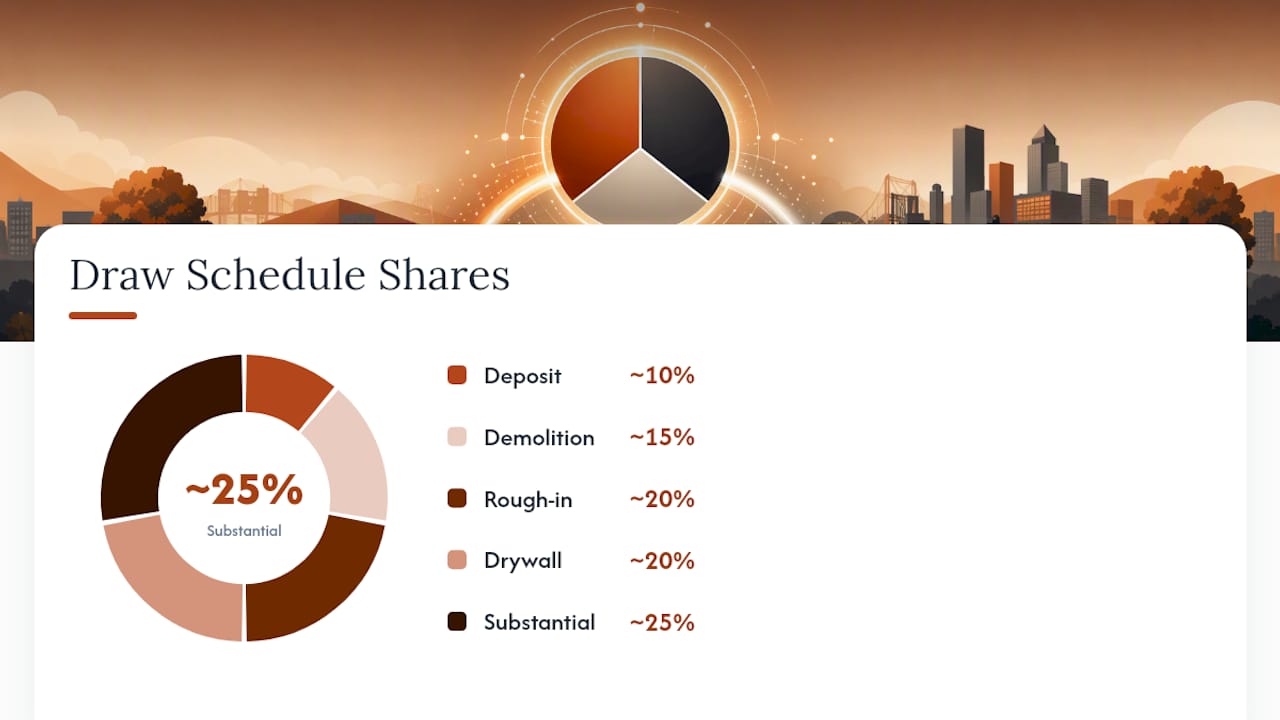
A six-milestone draw schedule is a reasonable starting structure for a standard rehab. Treat the splits below as illustrative, not a fixed rule; adjust for scope size and lender requirements.
- Deposit at contract signing, roughly 10%
- Demolition complete, roughly 15%
- Rough-in complete (plumbing, electrical, HVAC), roughly 20%
- Drywall complete, roughly 20%
- Substantial completion (paint, trim, fixtures installed), roughly 25%
- Final retention, the remaining 5 to 10%, released only after punch-list sign-off
Every draw needs the same verification before a check moves: photos of the completed milestone, a walk-through or inspection sign-off, and a signed conditional waiver and release on that payment. Skip any one of those three and you’ve got no defense if the work gets disputed later.
Hold a portion of the budget in retention until the punch list closes. The exact amount varies but retaining some leverage encourages contractors to complete final small tasks before project close. Close the reconciliation once retention releases: final budget vs. actual, punch list signed, and profit calculated against the ARV you underwrote on day one.
What Is “Driving for Dollars” as a Lead Sourcing Method?
Outside the operations context this article covers, “driving for dollars” is a term real estate investors use for a specific prospecting method. It means driving target neighborhoods to spot distressed, vacant, or neglected properties, then tracking those addresses to pursue as off-market deals.
The term comes from wholesale and investment circles, where windshield time is treated as a lead generation channel. An investor drives blocks systematically, logs addresses that show signs of distress, then works backward to find and contact the owner. It’s a sourcing strategy, not an operations one. The property hasn’t been bought yet when this work happens.
That distinction matters because the tools and skills are different. Sourcing work is about pattern recognition on a windshield tour and owner outreach afterward. Operations work, the subject of this article, starts once you’ve already closed and moved into comping, budgeting, and running a crew. A flipper doing both needs two different skill sets and, in most cases, two different pieces of software.
This article doesn’t cover the sourcing method further. The rest of the operational playbook above, comping to profit tracking, applies once a property is already under contract or owned, regardless of how it was found.
How Do Investors Spot Deals While Driving Neighborhoods?
Investors using this sourcing method look for specific, repeatable signals rather than driving at random. A systematic route through a target zip code, block by block, produces more consistent leads than sporadic drives through wherever looks promising that day.
Common practices include:
- Driving during daylight hours on weekdays, when yard maintenance and mail pileup are easiest to spot
- Working one neighborhood at a time rather than covering wide territory thinly
- Logging every candidate address immediately, not from memory later
- Cross-referencing county tax records against the addresses collected
- Repeating the same route periodically, since distress signals change over weeks
Consistency beats intensity here. A route driven once a week for two months surfaces more legitimate leads than one marathon session covering the whole city. Investors who treat this as a scheduled task, not an occasional errand, build a larger and more current list of candidate addresses over time.
None of this activity is part of the operations workflow this article is built around. It happens before a purchase, and it uses a different toolkit entirely. The overlap between sourcing and operations is limited to one thing: the property that gets found this way eventually needs the same comping, budgeting, and scheduling discipline as any other acquisition once it closes.
Which Apps Help Log Properties Found While Driving?
Investors using this method typically rely on a combination of mapping tools, note-taking apps, and dedicated lead-tracking software to record what they find on a drive. A phone’s GPS pin drop, paired with a voice memo or a quick photo, is the minimum viable version of this system.
More structured setups use apps built specifically for logging drive-by leads, which typically capture the address, a photo of the property, GPS coordinates, and a distress rating, then sync that data to a spreadsheet or CRM for follow-up. Some investors pair this with county assessor lookup tools to pull owner name and mailing address without leaving the car.
This entire category of tool solves a different problem than the software covered in the rest of this article. A lead-capture app tells you where a distressed property sits and who might own it. It does nothing once that property is under contract. At that point, the work shifts to comping, budgeting, and scheduling, the operations layer this article is about, and a different kind of software takes over.
What Visual Signs Indicate a Property Worth Pursuing?
Investors driving for leads train themselves to spot a short list of physical signals that correlate with distress, vacancy, or owner motivation to sell. No single signal is conclusive on its own; the pattern across several signals is what makes an address worth researching further.
Signals commonly cited include:
- Overgrown lawn or landscaping left unmaintained for an extended stretch
- Boarded or broken windows
- Visible mail or newspaper accumulation
- A roof in obvious disrepair, sagging or missing shingles
- Peeling paint or siding damage untouched for a long period
- Multiple code-enforcement notices posted on the door or window
- A for-sale-by-owner sign that’s been up for months with no activity
A property showing two or three of these signals is worth a closer look. One overgrown lawn on an otherwise well-kept block might just mean the owner is traveling. A property with an overgrown lawn, a boarded window, and a stack of undelivered mail is a different story.
None of these visual cues have anything to do with whether the eventual rehab will be profitable. That assessment happens later, once you’ve got an address and a seller conversation, and it depends on comps, repair costs, and the ARV math covered in the operations sections above.
How Do You Reach Out to a Property Owner You’ve Found?
Once an investor using this sourcing method has an address and identifies the owner through county records, the standard next step is direct outreach: a mailed letter, a phone call if a number is available, or in some cases a knock on the door.
Mailed letters remain a common first touch because they’re low-pressure and give the owner time to respond on their own schedule. Skip tracing services can locate phone numbers tied to a mailing address when the owner doesn’t live at the property, which is common with inherited or absentee-owned homes. Some investors follow up a letter with a call a week or two later if there’s no response.
Direct knocks work but carry more risk of an awkward or hostile reception, so most experienced investors reserve that approach for addresses where other contact methods have failed.
This entire outreach process happens before any of the acquisition or operations work covered elsewhere in this article. Contacting an owner successfully might lead to a purchase contract, at which point comping, budgeting, and the rest of the operational playbook take over. It’s a separate skill from running the rehab that follows.
What Legal Rules Apply to Contacting Property Owners?
Reaching out to a property owner found through this sourcing method carries real legal exposure if done carelessly, and the rules vary by state and by contact method.
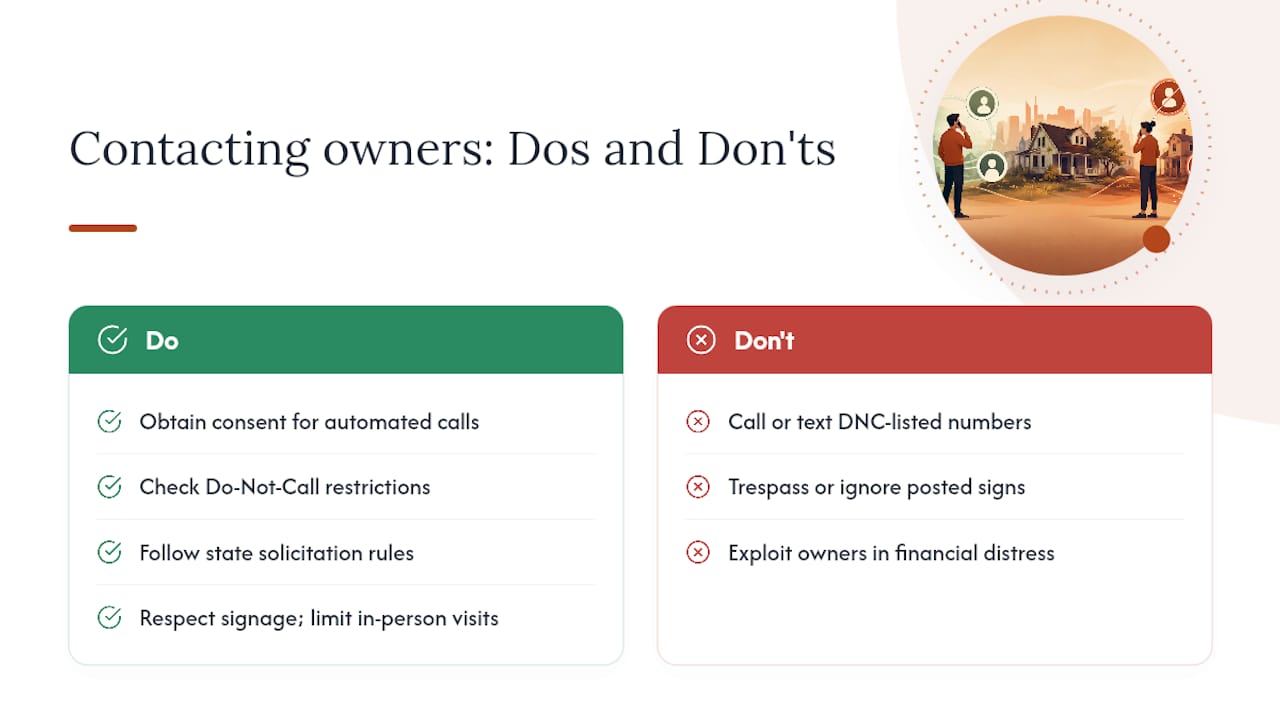
Phone outreach falls under the federal Telephone Consumer Protection Act, which restricts unsolicited calls and texts to numbers on the National Do Not Call Registry and requires consent for certain automated contact methods. Mailed letters carry fewer federal restrictions but some states regulate solicitation language, especially around foreclosure or distressed-property outreach, where consumer-protection statutes specifically target predatory approaches to owners in financial trouble.
Trespassing law matters for in-person visits. Walking onto private property to knock on a door is generally legal if done briefly and without disregarding posted no-trespassing signage, but repeated or aggressive visits can cross into harassment, which carries its own civil and sometimes criminal exposure depending on the state.
Beyond the legal floor, the ethical bar is worth holding yourself to separately. An owner in foreclosure or financial distress is a vulnerable counterparty. Pressure tactics or misleading claims about market value or timeline erode trust in the investor community broadly and can trigger state attorney general complaints in the more aggressive cases.
None of this legal framework applies to the operations work covered in the rest of this article. Once a property is under contract, the legal exposure shifts to construction contracts, lien law, and lender compliance, which is a different set of rules entirely.
Get Early Access to FLIP
Every step in the playbook above, comping, three-column budgeting, scope and finish packets, dependency-based scheduling, draw workflows, lien-waiver capture, and profit tracking against the original underwriting, is what software like FLIP aims to run.
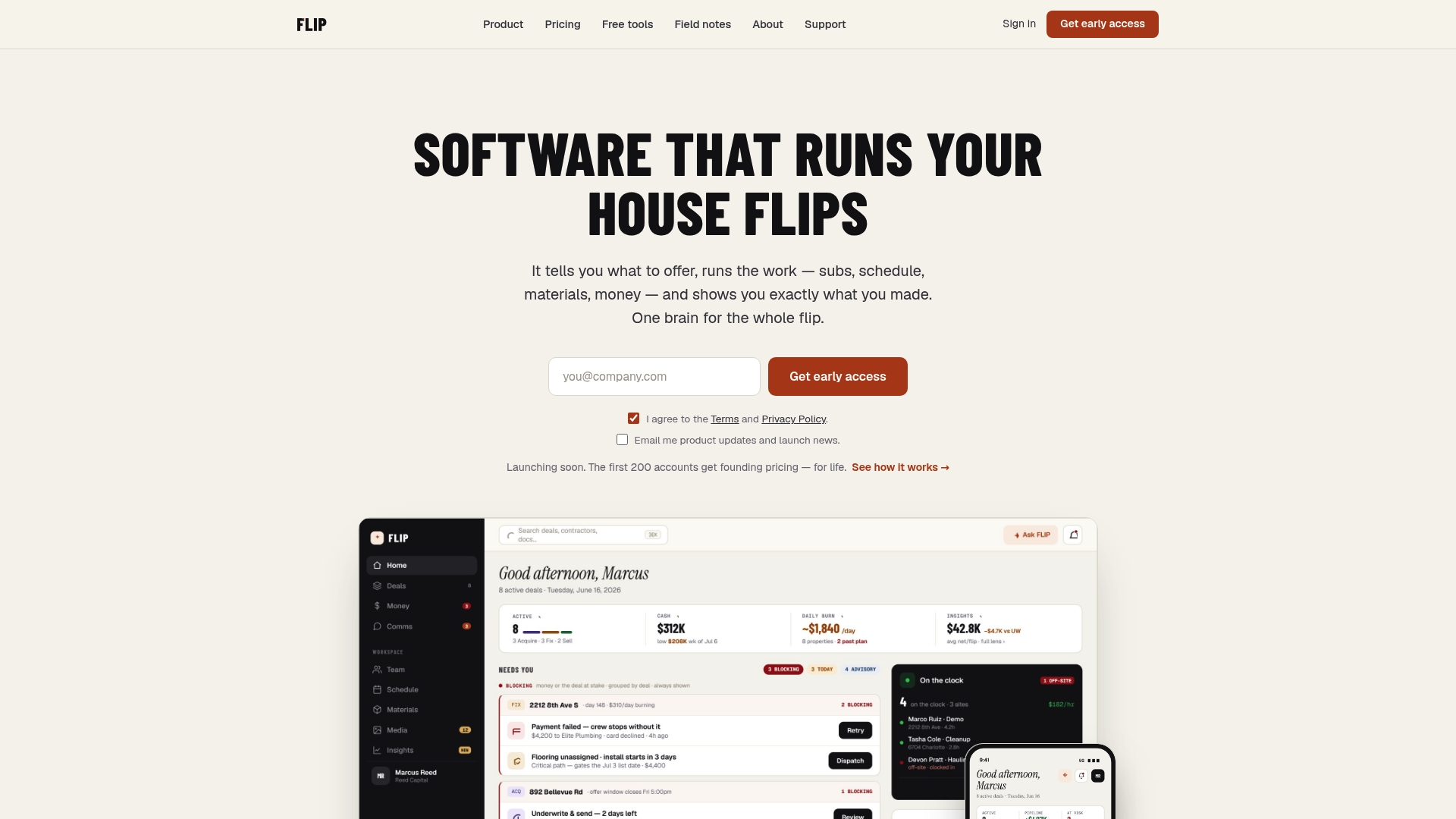
The platform would attach ARV and comps directly to the project record, so the number you underwrote on day one stays visible through the rehab instead of getting buried in a separate spreadsheet. Budgets would track estimated, contracted, and actual side by side, with contingency broken out as its own line. Scopes and finish packets would live with photo attachments and version history, so a change order is logged, not lost in a text thread.
Contractors and subs would log in through a phone-number login, free of charge, with W-9s and lien waivers captured before any draw releases. Draw requests would move through a documented workflow built for lender coordination, with photo-verified milestones tied to each disbursement.
FLIP is in early access. Model your numbers now with the hard money loan calculator or the full set of free flip calculators covering ARV, profit, and holding costs. Request early access at Flip to be among the first operators running a flip through the system.
FAQ
When Should a Draw Actually Get Released?
Only after the milestone is verified: photos of the completed work, an inspection or walk-through sign-off, and a signed conditional waiver and release covering that specific payment.
What Happens if a Contractor Won’t Sign a Lien Waiver?
Don’t release the check. A disbursement without a waiver leaves title exposed to a mechanic’s lien, which can stall or kill your sale later.
How Much Retention Should I Hold Back?
Most professional operators hold 5 to 10% until the punch list is verified complete, which keeps leverage to get final fixes done without a second trip out.
Do I Need Different Software for Finding Deals and Running Them?
Generally yes. Lead-sourcing tools track addresses and owner contact information; a platform like FLIP handles what happens after you close, from comping through profit tracking.
How Often Should I Reconcile Budget vs. Actual?
Weekly during the rehab for cash position and variance, then a full reconciliation at project close comparing final actuals against the original underwriting.
Recommended
FLIP runs the whole job — scope, subs, schedule and money on one record.