Signable Scope of Work Template for Flippers: Copy Ready Language

A scope of work template is the reusable document that spells out what a project delivers, how, when, and under what conditions. Fill it in for each job instead of writing one from scratch. Three sections do the heavy lifting: quantified deliverables, explicit exclusions, and acceptance criteria. Get those three wrong and the rest of the document is decoration.
TL;DR:
- Clear, specific deliverables and acceptance criteria are essential to avoid disputes, with each tied to measurable tests and review windows.
- Including detailed exclusions, milestones with attached payment triggers, and a written change-control process strengthens enforceability.
- Attach the scope of work to a master service agreement for ongoing projects or treat it as a standalone contract for single jobs to ensure clarity.
- Prepare and review the scope by collecting all project materials beforehand, and document all responsibilities, assumptions, and deadlines precisely.
- Store signed SOWs in a structured system, naming files with project and date details, and always use signed physical or digital signatures for enforceability.
Table of Contents
- What Scope of Work Templates Are Available to Download?
- What Sections Does a Scope of Work Need to Include?
- How Do You Fill Out a Scope of Work Template Step by Step?
- What Does Sample Scope of Work Language Look Like?
- What Mistakes Turn a Scope of Work Into a Dispute?
- How Do You Write a Change-Control Clause That Holds Up?
- How Should You Store and Version a Scope of Work?
- Who Wrote This Guide?
- How FLIP Turns a Scope Into an Enforceable Job
- FAQ
What Scope of Work Templates Are Available to Download?
Format depends on what happens to the document after it’s signed. A Word or Google Docs version is right for drafting, since both sides can track comments and argue over wording before anything is final. A PDF is the version you both sign and lock, the copy that gets pulled out when there’s a dispute. Excel or Sheets earns its place when the scope includes a budget or a payment schedule tied to milestones, because line items and formulas belong in a spreadsheet, not a paragraph.
Template variants worth keeping on hand:
- General/simple SOW — short projects, single deliverable, minimal phasing.
- Construction/rehab SOW — deliverables broken out by room or trade, with a materials and labor split.
- Software or web project SOW — feature lists, environments, and revision rounds instead of square footage.
- Consulting/agency SOW — hours, deliverable formats, and a retainer or milestone payment structure.
Attach the SOW as an exhibit to a master service agreement when you expect multiple projects with the same client over time. Write it inline, as one standalone contract, for a single job with no follow-on work planned. A rehab scope checklist works as a starting point for the construction variant, since it’s already organized by house condition and trade.
What Sections Does a Scope of Work Need to Include?
A scope of work defines project boundaries: the work to be performed, the deliverables, the timeline, and who’s responsible for what. It functions as the reference document when something goes sideways, so every section below earns its place because a dispute will eventually test it.
- Project overview and objectives. One or two plain sentences. What is this project, and what does success look like when it’s done.
- Deliverables. Noun-based, quantified items, not activities. “Repaint interior walls, three bedrooms and hallway, two coats, client-selected color” beats “paint the house.”
- Tasks or work breakdown structure. Group by phase and name an owner for each task group.
- Timeline and milestones. Real dates, each one tied to a specific deliverable, not a vague week range.
- Roles and responsibilities. What the provider does, what the client is on the hook for (access, approvals, materials).
- Assumptions and dependencies. List anything the scope depends on: permit turnaround, third-party inspections, client-supplied specs, with dates attached.
- Exclusions. State plainly what is not included. Exclusions are as critical as inclusions. An explicit out-of-scope list is what justifies a change order later.
- Acceptance criteria. Concrete tests, not adjectives. “Client has five business days to inspect and reject in writing; no response equals acceptance.”
- Payment terms and invoicing triggers. Tie each payment to a milestone acceptance, not a calendar date alone.
- Change-control process and signature block. Who can approve a change, how it gets priced, and where both parties sign.
Vague deliverables and missing acceptance windows are the two most common failure points in a scope document, and they’re the two easiest to fix with specific language instead of general description.
Pro Tip: Write deliverables as nouns you could hand someone, not verbs describing effort. “Deliver 12 finished cabinet doors” is enforceable. “Improve the kitchen” is not.
How Do You Fill Out a Scope of Work Template Step by Step?
Start before you open the document. Collect the project spec, the stakeholder list, any acceptance standards the client already has in mind, and reference materials like drawings or prior comps. Trying to write a scope from memory is how exclusions get skipped.
- Draft the overview and objectives first, in plain language, one or two sentences.
- Convert the scope into a deliverables list, then attach an acceptance test to each one.
- Break every deliverable into tasks, and assign an owner to each task group.
- Set milestone dates, and tie each milestone to a payment amount.
- Write assumptions and exclusions as separate bulleted lists, not buried in a paragraph.
- Insert the change-control clause and leave a signature block with a date line for both parties.
- Read the whole draft once as if you were the other party looking for a way to demand free work. Fix whatever you find.
That last step matters more than it sounds. A scope of work is a defense document. Explicit in-scope and out-of-scope lists give the project lead something to point to when a client asks for extra work without extra payment. If the document doesn’t give you that leverage, it isn’t finished yet.
What Does Sample Scope of Work Language Look Like?
Copying real sentences beats staring at a blank field. Here’s language for two common project types.
Website project:
- Deliverable: “Five-page responsive website (Home, About, Services, Contact, Blog index), delivered in staging environment within 30 days of kickoff.”
- Acceptance: “Client has five business days from delivery to submit written revision requests. No response within that window constitutes acceptance.”
- Payment trigger: “50% due at kickoff, 25% due at staging approval, 25% due at launch.”
Rehab/renovation project:
- Deliverable: “Replace flooring in kitchen and both bathrooms with client-selected LVP, materials and labor itemized separately.”
- Acceptance: “Provider submits photo documentation of completed work per room; client has three business days to flag defects before draw release.”
- Inspection language: “Final walkthrough scheduled within 48 hours of substantial completion notice.”
Sample change-order clause: “Any work outside the deliverables listed in Section 3 requires a written change request specifying the added scope, estimated cost, and revised timeline. [Owner name] must approve in writing before work begins. No verbal approval is valid.”
Breaking rehab deliverables by room with a materials-and-labor split makes both acceptance and invoicing traceable, which matters the first time a client questions a draw. Adjust the complexity of the sample language to match the project. A one-day repair job doesn’t need the same clause density as a full gut rehab, but the acceptance window and payment trigger structure should carry over regardless of size.
What Mistakes Turn a Scope of Work Into a Dispute?
Six mistakes account for most SOW disputes: vague deliverables, no defined review window, missing exclusions, no payment triggers tied to milestones, internal jargon the client can’t parse, and no written change-control process. Any one of these is enough to start an argument. Two or more, and the document stops functioning as a defense.
Run this checklist before anyone signs:
- Every deliverable is a countable, specific item.
- Every milestone has a date and an acceptance test attached.
- Exclusions are listed, not implied.
- Every payment is tied to a milestone, not a calendar guess.
- The change-control clause names who approves changes and how they’re priced.
- Both signature lines have dates, not just names.
Pro Tip: Link every milestone acceptance directly to an invoice trigger. If a client stalls on sign-off, the payment stalls with it, which gives them a reason to respond fast instead of sitting on your work for two weeks.
How Do You Write a Change-Control Clause That Holds Up?
A signed SOW isn’t frozen. It’s a baseline that changes through written amendments only, never a phone call or a text that says “sure, go ahead.” A robust change-control clause needs a request form (what’s changing, why, estimated cost, timeline impact), a defined estimate window, and a named approver who isn’t just “the client” but a specific person with signing authority.
Acceptance criteria need the same specificity in the amendment as in the original scope: a review window and a capped number of revision rounds, so “final approval” doesn’t turn into an open-ended back-and-forth.
The process, step by step:
- Either party submits a written change request describing the added or altered scope.
- Provider returns a cost and timeline impact estimate within a stated number of business days.
- Named approver signs off in writing, or rejects with reasons.
- Both parties sign a formal amendment before any changed work begins.
Skip step four and you’re back to a verbal agreement, which is exactly what a scope of work exists to prevent.
How Should You Store and Version a Scope of Work?
Attach the SOW to a master service agreement when a client has multiple projects with you over time; the MSA sets the legal and payment terms once, and each SOW locks down execution details for one job. For a single standalone project, the SOW can stand alone as the full contract.
- Name files with the project and effective date:
ClientName_SOW_2026-03-15.docx, notScope_final_v3.docx. - Draft and comment in an editable format; the moment both parties agree, convert to PDF and treat that as the only authoritative copy.
- Store signed SOWs alongside their MSA, not scattered across email threads.
- Capture actual signatures, not a typed name in an email reply. That gap is where “I never agreed to this” arguments start.
Who Wrote This Guide?
The FLIP team runs house flips before it writes about them. FLIP’s founder co-runs Ugly Duckling Houses, a Southeast Wisconsin flipping business, and built the rehab scope checklist out of the same field problems this article describes: vague scopes, missing exclusions, contractors invoicing for work nobody agreed to in writing.
Beyond the checklist, FLIP’s field notes cover scoping decisions on real rehab jobs, and the free calculator suite helps tie deliverable line items back to a repair budget before a scope ever goes to a contractor for bid. None of this replaces a signed contract. It’s the operational layer underneath one.
How FLIP Turns a Scope Into an Enforceable Job
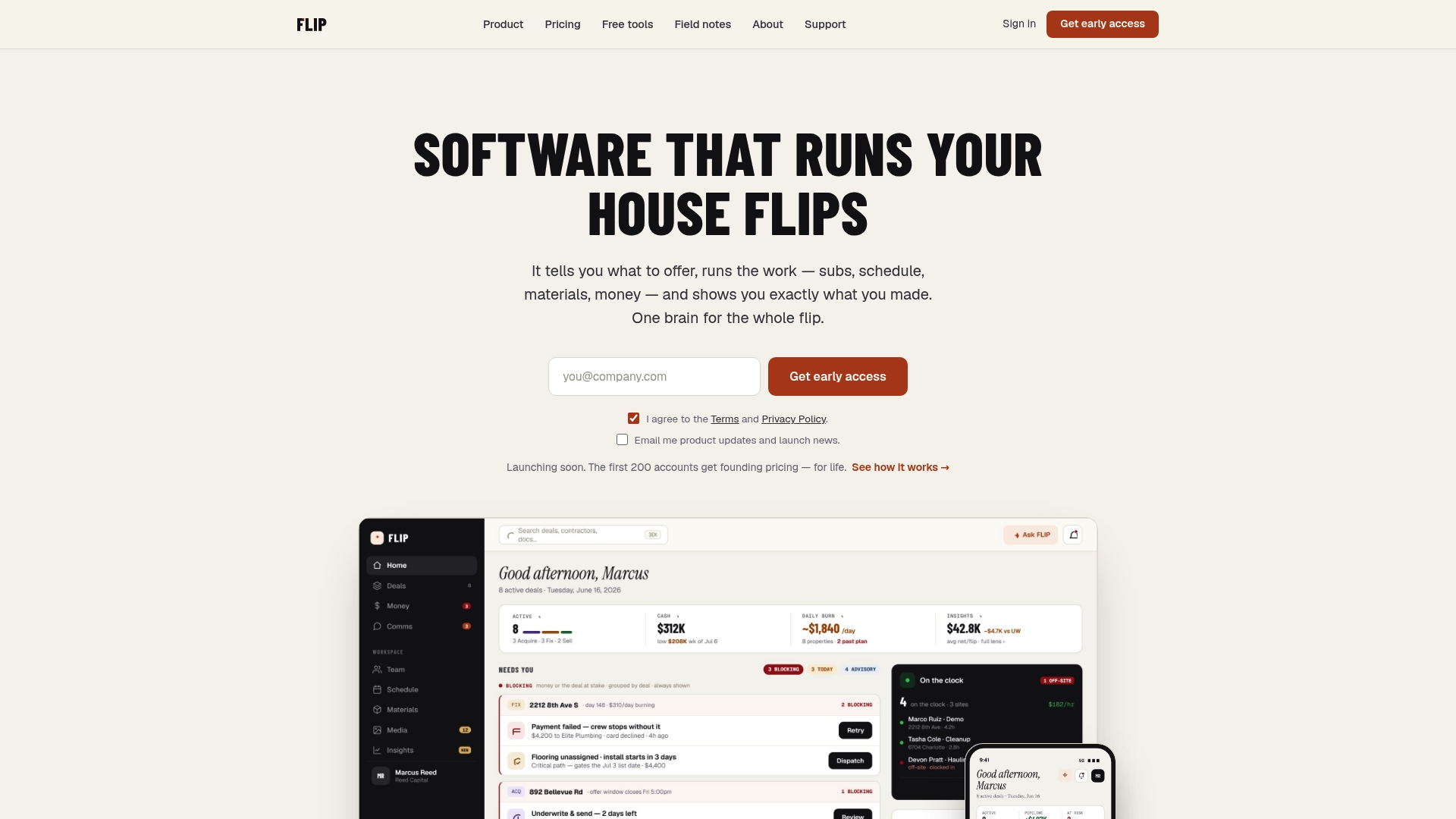
A scope of work only holds up if the paperwork behind it matches. FLIP is the operations layer for a flipping business, starting after comps and running through scope, scheduling, sub bidding, and payment approval. A written scope means nothing if a sub gets paid before the work matches what the scope promised. FLIP ties draw releases to photo-verified milestones, so the acceptance criteria in your SOW connect directly to what actually triggers payment.
Three places to start:
- Free flip calculators — run the numbers a scope depends on before you commit to a deliverable list.
- FLIP product overview — see how scope, scheduling, and payment approval would work as one system.
FLIP is pre-launch. Early access is open now at Flip for flippers who want scope, draw schedule, and lien waiver tracking in one place instead of six spreadsheets.
FAQ
How Do You Write a Scope of Work?
Start with a plain-language project overview, then list deliverables as quantified, countable items rather than activities. Add tasks with owners, milestone dates tied to payments, assumptions, exclusions, acceptance criteria with a review window, and a written change-control clause before both parties sign.
What Is an Example of a Scope of Work?
A rehab example: “Replace flooring in kitchen and both bathrooms with client-selected LVP flooring, materials and labor itemized separately, completed within 10 business days of material delivery, with photo documentation submitted per room for client review.” That single sentence covers deliverable, format, timeline, and acceptance in one line.
What Should a Scope of Work Form Look Like?
A complete SOW form includes a project overview, a deliverables list, a task breakdown, a timeline with milestones, roles and responsibilities, assumptions and exclusions, acceptance criteria with a defined review window, payment terms tied to milestones, a change-control clause, and a signature block with dates for both parties.
How Long Should a Client Have to Reject a Deliverable?
A common range is three to five business days from delivery, stated explicitly in the acceptance criteria section, with silence past that window counting as formal acceptance. Shorter windows work for small deliverables; larger phases may need longer review periods.
What’s the Difference Between a Scope of Work and a Master Service Agreement?
A master service agreement sets the legal and commercial terms that apply across a relationship, while a scope of work defines the execution details, deliverables, and acceptance criteria for one specific project. A single MSA can have multiple SOWs attached to it as new projects start.
Recommended
FLIP runs the whole job — scope, subs, schedule and money on one record.