How to Run Comps for a Defensible Property Value

A defensible value range comes from 3 to 6 recent, nearby closed sales, not one automated estimate. Pull comps that match location, size, and condition. Calculate price per square foot for each one. Adjust in dollars for the differences that remain. Reconcile the adjusted numbers to a range, then use that range to set ARV, list price, or your maximum allowable offer.
That workflow works whether you’re pricing a listing or underwriting a flip. Here’s the short version:
- Gather 3 to 6 closed sales within 0.5 miles, sold in the last 90 days
- Match square footage within 15 to 20 percent, same property type, similar beds and baths
- Calculate price per square foot for each comp and find a typical value
- Adjust each comp in dollars for condition, garage, and size differences as needed
- Reconcile to a value range, then set ARV or MAO accordingly
Software like FLIP exists to record that comp set and carry it straight into your underwriting instead of leaving it in a spreadsheet nobody checks later.
Key Takeaways
A defensible property value comes from 3 to 6 recent closed comps, price-per-square-foot math, and documented dollar adjustments reconciled to a range.
| Point | Details |
|---|---|
| Use enough comps | Pull a minimum of three closed sales, five or more when possible, to reduce outlier risk. |
| Default to tight filters | Start at 0.25 to 0.5 miles, 90 days, and ±15 to 20 percent square footage before widening. |
| Adjust in dollars, not percentages | Use paired-sale data where possible and flag any comp needing over 25 percent in total adjustments. |
| Verify before you publish | Cross-check portal data against MLS or county records before handing a number to an investor. |
| Carry the number forward | FLIP records the comp set and ties it directly to ARV, rehab scope, and profit tracking. |
Table of Contents
- What Are Comps and Why Do They Matter?
- Where Can You Find Comparable Sales Data?
- How Do You Filter Comps for a Valid Comp Set?
- How Do You Calculate and Reconcile Comp Values?
- What Mistakes Throw Off a Comp Analysis?
- When Should You Bring in an Agent or Appraiser?
- How Does FLIP Support Comp-Driven Underwriting?
- What Are the Legal and Ethical Limits on Using Comps?
- Get FLIP Early Access for Comp-to-Close Underwriting
- Sources
- FAQ
What Are Comps and Why Do They Matter?
Comparables, or comps, are recent closed sales that match a subject property on location, size, and condition. They’re the raw material for every credible valuation: a listing price, an offer, an ARV for a flip.
Automated valuation models estimate price from public data and algorithms with no human review. They’re fast, but algorithmic estimates carry a range of median error rates on active listings, which is exactly why lenders, appraisers, and serious investors won’t underwrite off one alone. Comps are transaction-based. Someone actually paid that price, for that house, on that date.
Three sources dominate professional comp pulls:
- MLS: the gold standard for detail and accuracy, though it usually requires an agent or a paid data platform
- County records: legally recorded and authoritative, but they typically lag MLS by 30 to 90 days
- Zillow and Redfin sold filters: free, fast, good for a first pass before you verify against MLS or county data
Where Can You Find Comparable Sales Data?
Each source has a different search path, and skipping steps costs you accuracy later.
- Zillow: search the neighborhood, open filters, switch from “For Sale” to the recently sold view, then sort by distance or date.
- Redfin: use the Sold tab on the map, draw a custom radius around the subject property, and filter by property type.
- County assessor or recorder site: search the subject address or parcel number, then pull recorded deed transfers for nearby parcels to confirm actual sale prices.
- MLS through an agent, or a paid data platform: request a pull when the market is thin or when you need verified days-on-market and concession data that public portals don’t show.
Free portals are fine for a first pass. They fall short on concessions, exact sale terms, and freshness. MLS-backed data provides more detail than public portals for exactly that reason, which is why agents and appraisers default to it and treat portal numbers as a starting point, not a final answer.
Whatever the source, record the same fields for every comp: address, sale price, sale date, square footage, beds and baths, distance from the subject, condition, and any known concessions.

Pro Tip: Build a standing template with those eight fields before you pull a single comp. Filling in blanks forces you to notice when a source is missing data instead of letting you quietly skip it.
How Do You Filter Comps for a Valid Comp Set?
Default filters keep a comp set honest. Start here, then document any move away from them.
- Radius: 0.25 to 0.5 miles
- Recency: sold within the last 90 days, extend to 180 if the market is thin
- Square footage: within ±15 to 20 percent of the subject
- Property type: matched exactly (single-family to single-family, not to a townhome)
- Bedrooms and baths: within one of the subject in each category
Cut a comp when it fails on arm’s-length terms. That means:
- Drop foreclosures and short sales unless the entire neighborhood trades that way.
- Drop sales between relatives, employers and employees, or other non-market transactions.
- Flag heavy seller concessions (paid closing costs, rate buydowns) and either adjust the price down or drop the comp.
- Note any deviation from the default filters directly on the comp sheet, with the reason.
Thin markets, rural parcels, unusual floor plans, break the defaults fast. When that happens, widen the radius first, then the timeframe, and write down why. A minimum of three closed comps is the floor for a defensible range; five or more is better because it dilutes the damage from any single outlier.
How Do You Calculate and Reconcile Comp Values?
Start every comp with the same math: sale price divided by square footage. Line up all your comps, and the median price per square foot becomes your anchor number before any adjustments happen.
From there, adjust each comp in dollars, not percentages, for the differences that remain. Paired-sale data (two nearly identical homes, one with a feature the other lacks) gives you the most defensible dollar adjustment for that feature. Where paired sales aren’t available, use a conservative, documented estimate instead of a guess. A widely used ceiling: if total adjustments on one comp exceed roughly 25 percent of its sale price, that comp is too different to trust, drop it rather than force it.
Weight comps by how closely they match. A sale two doors down, closed 20 days ago, at the same square footage, should carry more weight than one eight-tenths of a mile away from four months back. Outliers more than 15 percent off the median price per square foot get removed unless there’s a documented reason to keep them.
Here’s a simplified worked example for a 1,600 square foot subject property:
Steps behind the table:
- Calculate price per square foot for each comp. Here, all three land near $196 to $197, a tight cluster that supports confidence in the set.
- Apply dollar adjustments for the specific differences: garage, kitchen condition, bathroom age.
- Weight Comp A and B higher (closer distance, more recent sale), Comp C lower.
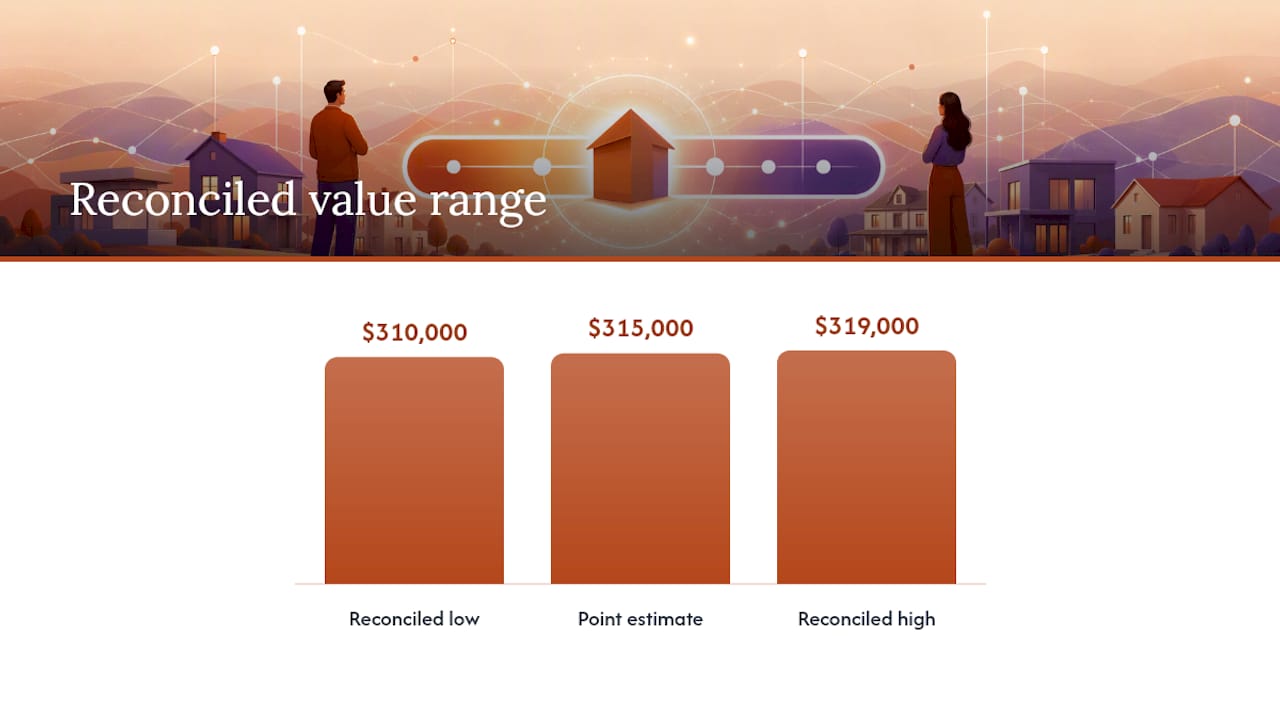
- Reconcile to a value range: roughly $310,000 to $319,000, with a point estimate near $315,000 for the subject at 1,600 square feet.
That reconciled number becomes your ARV. Everything downstream, MAO, rehab budget, target sale price, runs off it.
What Mistakes Throw Off a Comp Analysis?
A comp set built on sloppy inputs produces a confident-looking number that’s wrong. The usual culprits:
- Using list prices instead of closed sale prices, which inflates the whole set
- Missing seller concessions buried in the closing disclosure, not the MLS summary
- Over-adjusting for cosmetic differences (paint, staging) that buyers barely price in
- Including atypical sales: estate sales, distressed sales, or a one-off luxury renovation in an otherwise average block
When adjusted values scatter widely instead of clustering, don’t average your way out of it. Tighten the comp set first, radius, recency, condition matching, before trusting the number. If sold comps are scarce, pull active listings and pending sales for direction: pendings signal momentum, actives signal a ceiling, but closed sales still decide the final value.
Before handing numbers to an investor or a seller, run a quick gut check: does the price per square foot match what you’d expect for the block, and can you explain every adjustment in one sentence each? If not, the set needs more work.
When Should You Bring in an Agent or Appraiser?
Some situations call for professional access, not another public data pull:
- The property is unique enough that comps genuinely run thin (a converted barn, an odd lot shape)
- The market itself is thin, under three qualifying sales even after widening the radius
- A lender requires a formal appraisal before funding
- Final verification needs MLS-level detail you can’t get from public portals
Expect a CMA from an agent or a full appraisal report from a licensed appraiser, with cost varying by market and property type. Hand them your comp list, your dollar adjustments, photos, and a written note on every assumption you made. That saves them time and gets you a faster, more accurate second opinion.
How Does FLIP Support Comp-Driven Underwriting?
Comps that live in a spreadsheet get lost between the offer and the closing table. FLIP starts at comping the house and carries that number forward: comp capture, an ARV calculator, a rehab scope checklist, and profit tracked against the original underwriting, all in one system.
- Record the comp set once, with adjustments, and reuse it for ARV, MAO, and the rehab scope
- Track profit against the number you underwrote, not a revised guess made mid-project
- Built by the team behind Ugly Duckling Houses, a Southeast Wisconsin flipping operation, where comping was the first bottleneck operations had to fix
Documented comps and adjustments hold up better with lenders and partners than a verbal “the market supports it.”
What Are the Legal and Ethical Limits on Using Comps?
Comps are public-record math, not a license to misrepresent a property or a transaction. A few boundaries matter, whether you’re pricing a listing or underwriting a flip for a private lender.
Fair housing law governs how you describe neighborhoods and buyers when discussing comps publicly. Adjustments must track physical and locational differences, not the demographics of who lives nearby. Keep every comp conversation anchored to square footage, condition, and sale terms.
Only a licensed appraiser can issue a formal appraisal report, and only a licensed agent can produce an official CMA tied to a listing agreement. Running your own comps to underwrite a flip or set an internal target price is standard practice. Presenting your own comp analysis as a certified appraisal to a lender is not, and it can expose you to liability if the number turns out wrong.
Non-arm’s-length sales, deals between relatives, or transactions with hidden concessions distort a comp set and can mislead anyone relying on your number. Flag them, adjust for them, or drop them, but never present a distorted comp set as clean data to an investor, a partner, or a seller deciding on a listing price.
Document your assumptions. A comp set with a written rationale, why this radius, why this timeframe, why you excluded that one sale, protects you if a deal gets scrutinized later. Undocumented adjustments look like guesses, even when they’re not. The same discipline that makes a comp set defensible to an appraiser makes it defensible to anyone else who has to trust your number.
Get FLIP Early Access for Comp-to-Close Underwriting
Running comps by hand works until the fifth flip of the year, when the spreadsheet stops matching what actually happened on-site. FLIP is the operations layer that picks up right where comping starts and carries that number through rehab scoping, draw schedules, and profit tracking against the original underwriting.
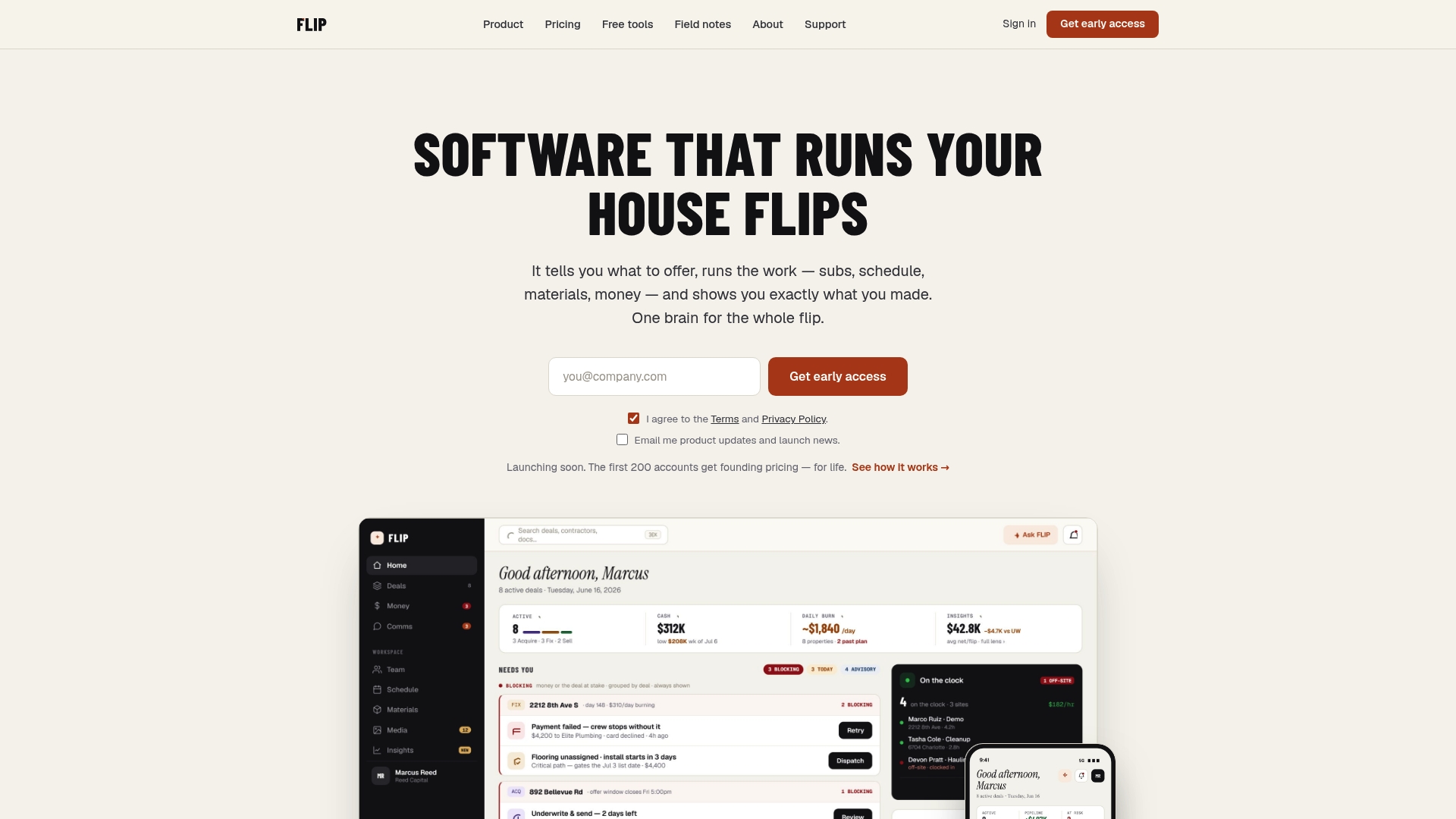
The flip profit calculator turns your reconciled ARV into a real profit estimate before you commit to an offer. The full suite of flip calculators covers holding costs and hard money terms, so the comp number you just built doesn’t sit isolated from the rest of the deal math.
FLIP is offered as early access for professional flippers running real deal volume, not a public trial. Check the FLIP product page for what’s built and what’s on the way, then request access to start tying comps directly to your underwriting instead of re-deriving them for every deal.
Sources
- Algorithmic home-value estimates and comps (Opendoor)
- How to pull comps on a house (iBuyer guide)
- How to Run Comps Like a Pro in 2026 (Deal Run)
- How to find real estate comps (Bankrate)
FAQ
Can I run comps myself without an agent?
Yes. Public portals, county records, and documented filters let any investor build a defensible comp set. MLS access through an agent adds detail but isn’t required for an internal underwriting number.
How do I look up comps for a specific property?
Search Zillow’s recently sold filter or Redfin’s Sold tab around the address, then cross-check sale prices against county recorder records for accuracy.
How far back do agents typically look for comps?
Most pulls target sales within the last 90 days, extending to 180 days only when the market doesn’t produce enough qualifying sales in that window.
How much does a real estate agent typically make on a $300,000 sale?
Commission structures vary widely by market and brokerage, and agents split commission with their broker, so there’s no single fixed figure that applies everywhere.
Recommended
FLIP runs the whole job — scope, subs, schedule and money on one record.